August 26
Freetown, Sierra Leone
This morning I walked up Tower Hill on an intended trip to Fourah Bay College. It's a well-known university that, prior to the war, played host to many students from other West African countries. Indeed, my Gambian friends from U. of Ghana only came to Legon after the war started and they were airlifted out by U.S. Marines. So they finished their studies in Ghana. On the way up I saw lots of people and families in their Sunday best on their way to church.
On my stroll I left the road and came upon a memorial to Milton Margai, first prime minister of independent Sierra Leone. While reading his biography, I was accosted by a pair of middle-aged men. It turned out I had wandered onto the grounds of the national parliament. Officer Conteh and Izwe took me to their office, where they announced that I was under arrest for "loitering with intent." I was told that ignorance does not excuse the crime, which was documented in an ad hoc report. I was then offered a brief tour of the grounds with my hosts/captors angling for something in return. They pointed out Fourah Bay College - up another hill and not especially pretty so I decided to give it a miss. We returned to their office and I joined them for breakfast (the universal staple - rice with cassava leaf sauce). Afterwards, having abandoned their requests for soft drinks, they escorted me down the hill and expressed the hope that Peace Corps would soon return to Sierra Leone.
18 September 2007


17 September 2007
Quotes from The Gambia and wider travels
As I sit in a cyber cafe in Ghana, I wonder how much of West Africa's internet usage is young African men posing as women and exchanging emails and instant messages with white men overseas. Hopefully the fiscal returns justify this...
First, a couple of quotes from a headmaster/principals meeting way back in March, discussing logistics of a prospective Cluster sports day and other issues.
Headmaster #1: "So it's agreed - three schools will contribute a sack of rice, the other eight will sell theirs and contribute the money."
Headmaster #2: "Don't forget to put the rice in another sack or the bitiks [stores] will try to cheat you because they know you shouldn't sell it."
Later, Cluster Monitor: "And, by the grace of God, your school will have a [football] field."
Headmaster of Bati Ndarr Lower Basic School: "God - sometimes he ignores things."
CM: "You! You are a Fula!"
August 1 - On the second day of our journey into Guinea, the driver took advantage of the rain and tossed some Omo powdered soap onto the windscreen. He then turned on the wipers to administer his improvised washer fluid. As I laughed at this display (carried out while driving), one of the passengers exclaimed, "C'est Afrique!", a familiar refrain after our night of breakdowns and washed-away roads.
August 3 - Exchange overheard on our abortive first attempt to reach Mali(ville).
Passenger: "Are we turning around because of the accident?"
Driver: "No, no, this is a different engine problem."
The accident in question took place just a couple of minutes after we left the car park/garage as our driver inexplicably veered off the road and into the gutter. We all got out and literally lifted the car out (gutters are deep in West Africa). Some time later the engine started acting up and the driver elected to return to the garage.
Sierra Leone
"I hear that in America they call the African a 'sex machine.' Is this true?" Fellow passenger on the road to Bo, while the driver attempts to fix the axle.
Liberia
Christiana, from Sierra Leone: "What you're doing is illegal."
Liberian police officer: "Just give me something small."
All ECOWAS citizens are officially free to travel through member states without visas or paying fees. As the ride from the border to Monrovia demonstrated (with 10 police/immigration stops on a 150 kilometre trip), this often matters little to low-paid officials. As far as extracting bribes, the Liberians on this stretch of road are the worst I've seen in my West African travels.
Christopher, a Nigerian in the car that was hit up so often for bribes: "Ghanaian taxis are really comfortable - only one person sits in the front seat."
First, a couple of quotes from a headmaster/principals meeting way back in March, discussing logistics of a prospective Cluster sports day and other issues.
Headmaster #1: "So it's agreed - three schools will contribute a sack of rice, the other eight will sell theirs and contribute the money."
Headmaster #2: "Don't forget to put the rice in another sack or the bitiks [stores] will try to cheat you because they know you shouldn't sell it."
Later, Cluster Monitor: "And, by the grace of God, your school will have a [football] field."
Headmaster of Bati Ndarr Lower Basic School: "God - sometimes he ignores things."
CM: "You! You are a Fula!"
August 1 - On the second day of our journey into Guinea, the driver took advantage of the rain and tossed some Omo powdered soap onto the windscreen. He then turned on the wipers to administer his improvised washer fluid. As I laughed at this display (carried out while driving), one of the passengers exclaimed, "C'est Afrique!", a familiar refrain after our night of breakdowns and washed-away roads.
August 3 - Exchange overheard on our abortive first attempt to reach Mali(ville).
Passenger: "Are we turning around because of the accident?"
Driver: "No, no, this is a different engine problem."
The accident in question took place just a couple of minutes after we left the car park/garage as our driver inexplicably veered off the road and into the gutter. We all got out and literally lifted the car out (gutters are deep in West Africa). Some time later the engine started acting up and the driver elected to return to the garage.
Sierra Leone
"I hear that in America they call the African a 'sex machine.' Is this true?" Fellow passenger on the road to Bo, while the driver attempts to fix the axle.
Liberia
Christiana, from Sierra Leone: "What you're doing is illegal."
Liberian police officer: "Just give me something small."
All ECOWAS citizens are officially free to travel through member states without visas or paying fees. As the ride from the border to Monrovia demonstrated (with 10 police/immigration stops on a 150 kilometre trip), this often matters little to low-paid officials. As far as extracting bribes, the Liberians on this stretch of road are the worst I've seen in my West African travels.
Christopher, a Nigerian in the car that was hit up so often for bribes: "Ghanaian taxis are really comfortable - only one person sits in the front seat."
15 September 2007
Time for an update!
I am presently in Grand Bassam, the old colonial capital of Cote d'Ivoire. I really should have attempted the occasional update while travelling, but the computers aren't always reliable, and I am often lazy.
Anyway; I shall move chronologically and gradually post descriptions of my travels:
circa July 27, 2007
Yesterday we had a nice visit to the Salls in Nord Foire (sp? it's on the outskirts of Dakar). The mother Fatou is a sister of my host father in Njau (Chebo), so I have stayed with them on past visits to Dakar. I was here with Jon, who had just arrived a couple of mornings ago (and, as luck would have it, his luggage arrived early the next morning.
Elhaas's wife Astou cooked a delicious chicken yassa, and I got to say goodbye to the Salls, we watched Senegalese TV/Brazilian soap operas, and I again got grief for not marrying Sohna, their cute cousin who dropped in.
Mot Lamin's coworker Jack, from (PR) China; had some interesting geopolitical news from The Gambia for me -- President Jammeh has announced that should China invade Taiwan, he is ready to send 1,000 soldiers to Taiwan's aid. Gambia, you may recall, is one of Taiwan's allies/client states in its quest for international recognition, along with Nauru, Vanuatu and others.
Senegal recently switched allegiances to China (well, in 2005). Around that time, in September '05, they had a falling-out with Gambia after the Gambians doubled the fares for their ferries. So the Senegalese government imposed a blockade of sorts, requiring all trucks going between Dakar and Casamance to drive around The Gambia. At the time, Senegalese president Abdoulaye Wade proposed the following solutions:
1) build bridges (the river's not very wide),
2) let Senegal control ferries of their own, or
3) dig a tunnel running under The Gambia since it's so small.
The matter was resolved a few weeks later, when Gambia sheepishly returned ferry prices to their pre-blockade rates.
Anyway; I shall move chronologically and gradually post descriptions of my travels:
circa July 27, 2007
Yesterday we had a nice visit to the Salls in Nord Foire (sp? it's on the outskirts of Dakar). The mother Fatou is a sister of my host father in Njau (Chebo), so I have stayed with them on past visits to Dakar. I was here with Jon, who had just arrived a couple of mornings ago (and, as luck would have it, his luggage arrived early the next morning.
Elhaas's wife Astou cooked a delicious chicken yassa, and I got to say goodbye to the Salls, we watched Senegalese TV/Brazilian soap operas, and I again got grief for not marrying Sohna, their cute cousin who dropped in.
Mot Lamin's coworker Jack, from (PR) China; had some interesting geopolitical news from The Gambia for me -- President Jammeh has announced that should China invade Taiwan, he is ready to send 1,000 soldiers to Taiwan's aid. Gambia, you may recall, is one of Taiwan's allies/client states in its quest for international recognition, along with Nauru, Vanuatu and others.
Senegal recently switched allegiances to China (well, in 2005). Around that time, in September '05, they had a falling-out with Gambia after the Gambians doubled the fares for their ferries. So the Senegalese government imposed a blockade of sorts, requiring all trucks going between Dakar and Casamance to drive around The Gambia. At the time, Senegalese president Abdoulaye Wade proposed the following solutions:
1) build bridges (the river's not very wide),
2) let Senegal control ferries of their own, or
3) dig a tunnel running under The Gambia since it's so small.
The matter was resolved a few weeks later, when Gambia sheepishly returned ferry prices to their pre-blockade rates.
19 July 2007
Mangee dem!
So, soon I will be an RPCV and enjoying some post-service travel in West Africa. My friend Jon is coming to Dakar on the 25th. From there we'll make our way to Guinea-Conakry, to visit another good friend of mine. While there, I'll try to put to use my rudimentary Puel Fouta (different from the Fula spoken in the Njau area) that my bean sandwich lady Kindeh taught me. She also gave me directions to her brother's house ("Get out of the car in the Bambeto Quartier and start asking for him"), so we may have a couple of people to visit. I'm looking forward to some nice upcountry hiking, and sour milk. This is going to be great!
After that, Jon will return and I shall chart a course for Ghana. After eight years away, I'm eager to catch up with old friends there, and to see what changes have taken place. I've heard and read a lot of good things about how the situation in Ghana is gradually improving, and I remember it as a place where people seemed motivated by the possibility of bettering their lives in the future. To be sure, it's still a very poor place, but I remember there being a lot of spirit there.
I'm not yet sure which route I shall take to Ghana; it will depend on the rains and the available modes of transport. I will go via Liberia or Mali, and I have potential hosts in both.
As for my Peace Corps service, I am ready to move on. I feel that I worked pretty hard while I was in Njau, although often on the micro-level, with individuals. Also, my direct style, though refashioned as time went on, often rubbed teachers the wrong way, so that I wasn't as effective as I could have been. Still, I got to know the community very well and shared ideas and thoughts with a lot of people. I think this can slowly lead people to reevaluate their life choices; it certainly helped to give me some perspective and to make me more accommodating. As for the students, they were the most fun to work with, since the reverence of elders here and general norms of politeness served me well here (i.e. I don't have to be as diplomatic around kids). In all, a satisfying experience and one that will help me with my future activities. I will miss Njau.
As for my post-travel plans, I expect to fly to the UK from Ghana. There I will stay with some good friends in Edinburgh, Scotland, work for up to a year, and look into graduate school in education -- either in the UK or through one of the Peace Corps Fellows programs.
After that, Jon will return and I shall chart a course for Ghana. After eight years away, I'm eager to catch up with old friends there, and to see what changes have taken place. I've heard and read a lot of good things about how the situation in Ghana is gradually improving, and I remember it as a place where people seemed motivated by the possibility of bettering their lives in the future. To be sure, it's still a very poor place, but I remember there being a lot of spirit there.
I'm not yet sure which route I shall take to Ghana; it will depend on the rains and the available modes of transport. I will go via Liberia or Mali, and I have potential hosts in both.
As for my Peace Corps service, I am ready to move on. I feel that I worked pretty hard while I was in Njau, although often on the micro-level, with individuals. Also, my direct style, though refashioned as time went on, often rubbed teachers the wrong way, so that I wasn't as effective as I could have been. Still, I got to know the community very well and shared ideas and thoughts with a lot of people. I think this can slowly lead people to reevaluate their life choices; it certainly helped to give me some perspective and to make me more accommodating. As for the students, they were the most fun to work with, since the reverence of elders here and general norms of politeness served me well here (i.e. I don't have to be as diplomatic around kids). In all, a satisfying experience and one that will help me with my future activities. I will miss Njau.
As for my post-travel plans, I expect to fly to the UK from Ghana. There I will stay with some good friends in Edinburgh, Scotland, work for up to a year, and look into graduate school in education -- either in the UK or through one of the Peace Corps Fellows programs.
18 July 2007
Faith in the Market...
Prior to my visit to Touba, my aunt Judy remarked on the large presence of Senegalese vendors in Italy these days.
An Economist article last year delved further into these itinerant traders, the vast majority of whom are Mourides. So here is a little more background on the Mouride diaspora. I switched from the Economist's link as it is now in their archive and unavailable, but at least here is the introduction.
An Economist article last year delved further into these itinerant traders, the vast majority of whom are Mourides. So here is a little more background on the Mouride diaspora. I switched from the Economist's link as it is now in their archive and unavailable, but at least here is the introduction.
13 July 2007
There IS wildlife in The Gambia!
In May, after a pair of abortive attempts, seven students, one teacher and I went to River Gambia National Park (I thought they had their own web presence, but cannot find it) across the river from Wassu-Kuntaur, near Sambel Kunda.
It was a nice environmental education weekend for the kids, and I think they appreciated the message about the value of animals, and the chance to see some. While Njau does have a little bush nearby, it's buffeted on all sides by farms and villages, leaving very little wildlife. In addition to the animals and relative remoteness of the setting, we also got to spend time on the river, something Njau kids don't do much (Njau's 12 kms from the river), and even scaled some rare hills.


The animals we saw included these hippos and some chimpanzees. The chimps were reintroduced to these midriver islands starting in 1978; before then they'd been extinct here since early in the 20th century. No visitors are allowed on the island, so the chimpanzees are left in peace, with the occasional visit from researchers. The hippos, too, benefit from the low level of development in the area, and restrictions in boat travel around the islands.


Lastly, one of the activities our students did was a blindfolded tree identification competition. The leaves from the various trees were hung on a line and my kids then felt, smelled and tasted them. Of our seven students, six scored 9 or more out of 11. I have trouble identifying them without being blindfolded! The kids are also well versed on the various uses of the trees, which helped our hosts emphasize the importance of preserving and planting as many trees as possible.

It was a nice environmental education weekend for the kids, and I think they appreciated the message about the value of animals, and the chance to see some. While Njau does have a little bush nearby, it's buffeted on all sides by farms and villages, leaving very little wildlife. In addition to the animals and relative remoteness of the setting, we also got to spend time on the river, something Njau kids don't do much (Njau's 12 kms from the river), and even scaled some rare hills.
The animals we saw included these hippos and some chimpanzees. The chimps were reintroduced to these midriver islands starting in 1978; before then they'd been extinct here since early in the 20th century. No visitors are allowed on the island, so the chimpanzees are left in peace, with the occasional visit from researchers. The hippos, too, benefit from the low level of development in the area, and restrictions in boat travel around the islands.
Lastly, one of the activities our students did was a blindfolded tree identification competition. The leaves from the various trees were hung on a line and my kids then felt, smelled and tasted them. Of our seven students, six scored 9 or more out of 11. I have trouble identifying them without being blindfolded! The kids are also well versed on the various uses of the trees, which helped our hosts emphasize the importance of preserving and planting as many trees as possible.
12 July 2007
Saying goodbyes
At the end of the year we had a few 'programmes' -- the Gambian word for parties. I ended up having three -- library helpers, school, women of Njau -- which may conjure up memories of my long goodbye amongst my friends in DC.

They were a good time, with music sets and goat meat at the school (see the first picture of the boys cleaning out the intestines), but the one at my compound (the red gates on the left mark the entrance) may have been more fun. There the women and girls just turned over a few metal bowls and plastic buckets, forged an open space and invited people to dance. The ataaya, lait and juice mixes flowed freely (compliments of my host mom and others). The parties were good fun, and a chance to say goodbye and thanks to a lot of my friends.


The last picture has me in Demba Sey's compound. Squatting is Danielle, my sister's toma/namesake, who is enjoying some leftover rice. Amie is sitting next to me. Danielle's older sister Isatou (well, she's just a week older) was afraid of the camera so she's trying to hide in her mother Kumba's fana.

They were a good time, with music sets and goat meat at the school (see the first picture of the boys cleaning out the intestines), but the one at my compound (the red gates on the left mark the entrance) may have been more fun. There the women and girls just turned over a few metal bowls and plastic buckets, forged an open space and invited people to dance. The ataaya, lait and juice mixes flowed freely (compliments of my host mom and others). The parties were good fun, and a chance to say goodbye and thanks to a lot of my friends.
The last picture has me in Demba Sey's compound. Squatting is Danielle, my sister's toma/namesake, who is enjoying some leftover rice. Amie is sitting next to me. Danielle's older sister Isatou (well, she's just a week older) was afraid of the camera so she's trying to hide in her mother Kumba's fana.
The iron ore train to Nouadibou
Some time ago, I belatedly wrote about my travels to Mauritania with my long-suffering friend Fatou Jallow. Well, the NYTimes Africa journalist was just there as, in additional to an article about a nascent campaign to wean Mauritanians off their love for hefty women, I came across an article about the train we rode to Nouadibou. I apologize if the article soon becomes inaccessible, but you may find it by searching for "Tough Commute on a Train Not Meant for People".
We did not go the whole distance, but instead joined the train at the 'station' in Choum, after a back of the pickup truck ride through the desert from Atar. We went westbound instead, so the cars were full of iron ore dust, which we flattened out to lay down in for the night.
Interestingly, it seems that large numbers of Pakistanis are using the train en route to Europe. You may recall Nouadibou as the port where many would-be sub-Saharan African migrants set out by boat for the Canary Islands and, it is hoped, greener pastures. This is an incredibly dangerous undertaking, as many boats are lost, with one unfortunate crew's remains eventually being discovered in the Bahamas. As far as I could tell, Fatou and I were the only non-Africans on the train, but we didn't check the passenger berths.
The funny thing is that this very alarmist article is in the same magazine whose cover story implores Americans to cast aside fear as we attempt to restore our place in the world.
We did not go the whole distance, but instead joined the train at the 'station' in Choum, after a back of the pickup truck ride through the desert from Atar. We went westbound instead, so the cars were full of iron ore dust, which we flattened out to lay down in for the night.
Interestingly, it seems that large numbers of Pakistanis are using the train en route to Europe. You may recall Nouadibou as the port where many would-be sub-Saharan African migrants set out by boat for the Canary Islands and, it is hoped, greener pastures. This is an incredibly dangerous undertaking, as many boats are lost, with one unfortunate crew's remains eventually being discovered in the Bahamas. As far as I could tell, Fatou and I were the only non-Africans on the train, but we didn't check the passenger berths.
The funny thing is that this very alarmist article is in the same magazine whose cover story implores Americans to cast aside fear as we attempt to restore our place in the world.
Medical breakthroughs in The Gambia
Given that I've been dutifully serving as an ambassador of sorts for my home country, I've done my best to avoid holding forth on Gambian politics and other developments.
The time seems right, though, to share some developments that took place in January. At that time, President Jammeh announced that he had discovered cures for asthma and AIDS, and viewers were treated to television programs showing the President treating the patients. This was widely reported in the domestic media, less so on the international scene.
Recently, though, I have come across two irreverent international pieces on the President's breakthrough. One was in a recent Economist. The other is a clip on Youtube, which I've heard much about but never before seen. Today was my inaugural viewing, with Meet the President - Yahya Jammeh - 14 May 07 - Part 1 as my first Youtube video. Riveting stuff.
The time seems right, though, to share some developments that took place in January. At that time, President Jammeh announced that he had discovered cures for asthma and AIDS, and viewers were treated to television programs showing the President treating the patients. This was widely reported in the domestic media, less so on the international scene.
Recently, though, I have come across two irreverent international pieces on the President's breakthrough. One was in a recent Economist. The other is a clip on Youtube, which I've heard much about but never before seen. Today was my inaugural viewing, with Meet the President - Yahya Jammeh - 14 May 07 - Part 1 as my first Youtube video. Riveting stuff.
An old picture from February '06
My good friend Sekouba took this picture in the market in Farafenni. I was haggling with Bitch, sorry, Ms. Bitch, over the trousers I'm holding. He held firm so I had to break down and pay 35 Dalasis ($1.20). The trousers have served me well to this day, and will be my 'smart' pair during my travels.


Religious life in The Gambia
So this won't be a very insightful piece; I want to upload the pictures. As I've mentioned in previous posts, the 'western' style schools face competition from madrassas, although attempts are being made to integrate them into the overall educational system.
Anyway, my friend Fatim (Grade 5 at Njau) goes to Dara (Koranic classes) on the weekends. In May her class had a day of teri, or recitals, so I dropped by her village (Lebba) on my way home to Njau from Kombo. So here are a couple of pictures of the community gathered around to listen, and Fatim performing her recitation. She was a bit nervous, but did well and helped show others that you can study both.


The Gambia as a whole is some 90-95% Muslim, and our students get daily Koranic instruction in the timetable. School ends at 1:45, so that everyone can perform ablutions in time for the 2 o'clock prayer, or thereabouts. So here are a couple of pictures of the daily ritual, with the consent of the teachers. Afterwards, it acts as our ad hoc announcements forum.


Anyway, my friend Fatim (Grade 5 at Njau) goes to Dara (Koranic classes) on the weekends. In May her class had a day of teri, or recitals, so I dropped by her village (Lebba) on my way home to Njau from Kombo. So here are a couple of pictures of the community gathered around to listen, and Fatim performing her recitation. She was a bit nervous, but did well and helped show others that you can study both.
The Gambia as a whole is some 90-95% Muslim, and our students get daily Koranic instruction in the timetable. School ends at 1:45, so that everyone can perform ablutions in time for the 2 o'clock prayer, or thereabouts. So here are a couple of pictures of the daily ritual, with the consent of the teachers. Afterwards, it acts as our ad hoc announcements forum.
11 June 2007
Mail Run hardship (for the recipients)
In April, Colleen and I and John the driver went on PC-TG's monthly mail run. The Gambia is so small that PCVs' mail can be delivered (well, to varying degrees of success) to their 100 or so sites in a six day trek.
Colleen's description of our delivery debacles is a good rendition of our trip, so I will not say much more. It was great fun to drive all over The Gambia, and take in the varied environments -- flat grassland, flat mangroves, flat forested areas. I also enjoyed seeing how PCVs dealt with their different living situations, and talking to their host families. In a tweak of the traditional mail run survey, we opted to interview PCVs' families while we were at it. Between Colleen's Mandinka and my Wolof, we were able to converse with just about all the compounds we visited (non-Mandinkas and -Wolofs usually know at least one of them as a second or third language). One notable exception was Stephanie/Bintu's site, which is way the fuck out there.
Colleen's description of our delivery debacles is a good rendition of our trip, so I will not say much more. It was great fun to drive all over The Gambia, and take in the varied environments -- flat grassland, flat mangroves, flat forested areas. I also enjoyed seeing how PCVs dealt with their different living situations, and talking to their host families. In a tweak of the traditional mail run survey, we opted to interview PCVs' families while we were at it. Between Colleen's Mandinka and my Wolof, we were able to converse with just about all the compounds we visited (non-Mandinkas and -Wolofs usually know at least one of them as a second or third language). One notable exception was Stephanie/Bintu's site, which is way the fuck out there.
16 March 2007
A Madrassa in the City
I had long promised to visit my friend Bubacarr, who works as an Ustas (Koranic teacher) at a dara/madrassa in Thies, Senegal's second city, during the dry season. Bubacarr comes home to Njau to farm during the rainy season, so that's how I know him. So it was that, after the Magal and a stopover in Dakar, I came to visit Thies.
I expected that some parents in Njau and other villages had left their sons in Bubacarr’s tutelage. I was surprised to discover, though, that all of his talibes/students were from around Njau, having moved 300 kilometres away to Thies. It seemed to me counterintuitive that Bubacarr, an Njau native, and his talibes would leave their homes and families for an expensive, unfamiliar city in another country. As it turns out, the rationale is economic.
If Bubacarr’s madrassa were in Njau, parents would not be able to pay him for his services. There are rural madrassas where children toil in their Ustas’s fields (see my July 18 2006 post on this), but Bubacarr lacks the land for this to be a viable option.
Moving to Thies proved feasible, though. The talibes’ parents still don’t have any money, and there’s no subsistence work available, but one can get by thanks to the West African and Islamic values of hospitality and zakat (alms giving), respectively.
Bubacarr rents a compound where he and his 40 or so students live and study. With water fees (there’s a tap in the compound), rent comes to 12,000 CFA (about $22) a month – a heady sum when your students have no money, nor food. This is where the aforementioned kindness of strangers, prescribed by social and religious norms, comes in.
The talibes spend a couple of hours every morning out with old tomate paste cans (for taking collections), offering prayers to people kind enough to make a contribution. A similar thing happens at lunch and dinner. The children return home with extra rice from compound food bowls and divvy it up at meal times. Bubacarr, too, has a couple of neighbours that provide him with meals, out of respect for the work he does teaching children the Koran and Islamic values.
The talibes study for a few hours before and after lunch, and for another hour or so at night. Older students teach the younger boys, with Bubacarr there to teach the older guys and to answer questions that come up. Bubacarr likened his role to that of my headmaster at Njau’s primary school.
So Bubacarr’s dara relies solely on charity to operate. At first this seemed unrealistic, but if every kid collects 25-50 CFA a day that works out to 1000-2000 CFA. Bubacarr had enough to splurge 2500 CFA on dinner for us (leaving me feeling a little sheepish), and is even contemplating renting a slightly nicer room. The funds also supported his two wives (now three as he has married his brother’s widow) and children at home in Njau.
So the urban dara system, in this case, works quite well financially. On the other hand, living quarters are cramped, the diet’s not great (but on a par with Njau), and Bubacarr and his talibes are far from home. Also, one boy is there simply because he ran out of money to attend government school, and Bubacarr has poached a few other kids from Njau’s primary school. It would be nice if more children simply took the two track approach – about 30 Njau LBS students pay for extra Koranic classes with the school’s Ustas – rather than making it an either/or proposition, but the money’s simply not there to support a madrassa in Njau.
Addendum: I did a brief Internet search on talibes, and most posts deplored the living conditions of dara students. Although the living conditions are difficult, I saw a generally happy atmosphere at Bubacarr’s school, and the talibes seemed to be treated reasonably well.
15 March 2007
The Magal pilgrimage in Touba!
On 6 March 2007 I traveled from Njau for the Magal/annual pilgrimage to Touba, Senegal. Assembled here are some random notes from letters I’ve been writing to friends.
The Magal is celebrated by followers of the Mouride sect, and commemorates the founder’s return from 20 years’ French-imposed exile in 1907. So this city gets up to two million visitors during the Magal (to put that in perspective, I think Saudi Arabia allots passes for two million pilgrims for the Hadj). About half of Senegal’s 11-12 million people are Mourides and a fair amount of Gambian Wolofs are too (and some Mauritanians). I traveled there with Njau’s imam, an old pa (Baay Pateh) from Njau who’s keeping an eye on me, and a few other people from Njau and the surrounding villages (we hired a gelegele/minibus, which went off the beaten track, heading north from Njau). Quite a few other people from the Njau area are here; I bumped into the gelegele driver from our Grade 6 class trip last May, among others. The first afternoon we were there, I visited the mosque with Baay Pateh. It’s very large and ornate, and there are several adjunct shrines/mausoleums dedicated to past leaders of the Mourides. Every main street branching out from the mosque is filled with shops and sidewalk stalls (I think we passed over 100 cell phone stores). Many of the Senegalese working overseas are Mourides, and there’s a lot of trade back and forth. A major characteristic of this and other Muslim brotherhoods in the region is their reverence of their Serignes/marabouts/leaders, and their belief that these leaders can be conduits of messages or prayers to Allah. A lot of other Muslims might consider this elevation of leaders to be un-Islamic, but it dovetails nicely with local traditions of consulting wizened men for help with health, family, or financial problems or needs.
Besides checking out the market/city, we spent our time hanging out in three compounds that our imam and Pateh know (we are among hundreds of people sleeping in their courtyards), chatting with various pilgrims curious about my presence here, going on expeditions to places to take a bath (Baay Pateh knows a couple of compounds about 30 minutes’ walk from us that had pretty reasonable bathing places, plus we didn’t have to fetch water – one time Pateh simply pulled rank and used his seniority to annex one unfortunate young man’s bucket of water and place in line), eating, and resting.
So that’s about all I can tell you about Touba. Most of my information may not be completely accurate, and I use some terms interchangeably that may not be completely correct. Still, it gives you a small idea of what the trip was like, along with this little ‘survival guide’ which I’ve put together for prospective Peace Corps travelers to the Magal.
Magal Survival Guide
Although this won’t match the attention to detail in Tina and Nate’s Mauritania brief (“The pit latrine in the Atar PCV house issues a pleasant report when you drop a solid stool…”), I will do my best to be helpful. I highly recommend the trip to anyone who is curious (some command of Wolof or French is vital – or a companion with those qualities).
Try to leave a couple of days before the Magal, as traffic and accommodation both get really tight.
Travel with Gambian or Senegalese friends
If your village/town has a fair amount of Wolof compounds, there’s a decent chance there are Mourides among them (some Mauritanians are Mourides too). Travelling with locals should mean that logistics (transport, accommodation) are taken care of.
Bring your own water?
This was the suggestion of my host father, who claims cholera is widespread in Touba during the Magal. To be sure the taps end up surrounded by cesspools, and the water tastes awful. I brought along a 20 liter bidong for myself and the old pa whose fare I sponsored, but this only lasted two days as the less-prepared members of our party helped themselves. Bottled/shrink-wrapped water can be bought, but it sold out the day of the Magal.
Bathing
This could be a battle. You could borrow someone’s bucket, or bring your own. On the plus side, the taps always run. I lucked out as my old pa is a Magal old hand, and found us some good bathing places, although they were a half hour’s walk away.
Sleeping
Plan on sleeping in what you wear. You may want to bring extra layers, and socks, as it was quite chilly and you’ll likely be exposed to the elements. You’ll need a mat or something to roll out over the sand. Mats can be bought in Touba at the usual rates. Sleeping will be cramped; the last night we squeezed our mat between a compound wall and a taxi.
Visiting the Grand Mosque
This can be a bit tricky (although they apparently give tours during quieter periods), but it you dress the part, speak some Wolof (a little Arabic would probably completely flummox and quieten interrogators), and have someone who can vouch for you (Baay Pateh banged on about how I fasted over Ramadan and was generally living as they do), you should be fine.
Theft
The crowds are overwhelming, so try to stash somewhere on your person any valuables you don’t need at hand. I found my khaftaan quite handy as it covered the items in my trousers. I left my clothes and such where my people were ensconced and nothing was taken. Basically, the usual precautions apply.
Toilets
The standard pit latrines, just count on sharing it with a few hundred people.
Food
There are plenty of street vendors to buy food from, and tones of bitiks. If your host is a Serigne, or Mouride spiritual leader, he’ll want to make a good show of taking care of his acolytes. Breakfast was tea and bread; lunch was benichin with vegetables and beef(!); dinner was cous with sauce and more beef. It was kind of like Tobaski, except cows were slaughtered instead of rams or goats.
EXPENSES
Roundtrip fare from CRD-North: 5000 CFA / D 250 / $9
Large mat: 4000 CFA / D 200 / $7.50
Drinks: 300 CFA / D 15 per person per day / $0.50
The Magal is celebrated by followers of the Mouride sect, and commemorates the founder’s return from 20 years’ French-imposed exile in 1907. So this city gets up to two million visitors during the Magal (to put that in perspective, I think Saudi Arabia allots passes for two million pilgrims for the Hadj). About half of Senegal’s 11-12 million people are Mourides and a fair amount of Gambian Wolofs are too (and some Mauritanians). I traveled there with Njau’s imam, an old pa (Baay Pateh) from Njau who’s keeping an eye on me, and a few other people from Njau and the surrounding villages (we hired a gelegele/minibus, which went off the beaten track, heading north from Njau). Quite a few other people from the Njau area are here; I bumped into the gelegele driver from our Grade 6 class trip last May, among others. The first afternoon we were there, I visited the mosque with Baay Pateh. It’s very large and ornate, and there are several adjunct shrines/mausoleums dedicated to past leaders of the Mourides. Every main street branching out from the mosque is filled with shops and sidewalk stalls (I think we passed over 100 cell phone stores). Many of the Senegalese working overseas are Mourides, and there’s a lot of trade back and forth. A major characteristic of this and other Muslim brotherhoods in the region is their reverence of their Serignes/marabouts/leaders, and their belief that these leaders can be conduits of messages or prayers to Allah. A lot of other Muslims might consider this elevation of leaders to be un-Islamic, but it dovetails nicely with local traditions of consulting wizened men for help with health, family, or financial problems or needs.
Besides checking out the market/city, we spent our time hanging out in three compounds that our imam and Pateh know (we are among hundreds of people sleeping in their courtyards), chatting with various pilgrims curious about my presence here, going on expeditions to places to take a bath (Baay Pateh knows a couple of compounds about 30 minutes’ walk from us that had pretty reasonable bathing places, plus we didn’t have to fetch water – one time Pateh simply pulled rank and used his seniority to annex one unfortunate young man’s bucket of water and place in line), eating, and resting.
So that’s about all I can tell you about Touba. Most of my information may not be completely accurate, and I use some terms interchangeably that may not be completely correct. Still, it gives you a small idea of what the trip was like, along with this little ‘survival guide’ which I’ve put together for prospective Peace Corps travelers to the Magal.
Magal Survival Guide
Although this won’t match the attention to detail in Tina and Nate’s Mauritania brief (“The pit latrine in the Atar PCV house issues a pleasant report when you drop a solid stool…”), I will do my best to be helpful. I highly recommend the trip to anyone who is curious (some command of Wolof or French is vital – or a companion with those qualities).
Try to leave a couple of days before the Magal, as traffic and accommodation both get really tight.
Travel with Gambian or Senegalese friends
If your village/town has a fair amount of Wolof compounds, there’s a decent chance there are Mourides among them (some Mauritanians are Mourides too). Travelling with locals should mean that logistics (transport, accommodation) are taken care of.
Bring your own water?
This was the suggestion of my host father, who claims cholera is widespread in Touba during the Magal. To be sure the taps end up surrounded by cesspools, and the water tastes awful. I brought along a 20 liter bidong for myself and the old pa whose fare I sponsored, but this only lasted two days as the less-prepared members of our party helped themselves. Bottled/shrink-wrapped water can be bought, but it sold out the day of the Magal.
Bathing
This could be a battle. You could borrow someone’s bucket, or bring your own. On the plus side, the taps always run. I lucked out as my old pa is a Magal old hand, and found us some good bathing places, although they were a half hour’s walk away.
Sleeping
Plan on sleeping in what you wear. You may want to bring extra layers, and socks, as it was quite chilly and you’ll likely be exposed to the elements. You’ll need a mat or something to roll out over the sand. Mats can be bought in Touba at the usual rates. Sleeping will be cramped; the last night we squeezed our mat between a compound wall and a taxi.
Visiting the Grand Mosque
This can be a bit tricky (although they apparently give tours during quieter periods), but it you dress the part, speak some Wolof (a little Arabic would probably completely flummox and quieten interrogators), and have someone who can vouch for you (Baay Pateh banged on about how I fasted over Ramadan and was generally living as they do), you should be fine.
Theft
The crowds are overwhelming, so try to stash somewhere on your person any valuables you don’t need at hand. I found my khaftaan quite handy as it covered the items in my trousers. I left my clothes and such where my people were ensconced and nothing was taken. Basically, the usual precautions apply.
Toilets
The standard pit latrines, just count on sharing it with a few hundred people.
Food
There are plenty of street vendors to buy food from, and tones of bitiks. If your host is a Serigne, or Mouride spiritual leader, he’ll want to make a good show of taking care of his acolytes. Breakfast was tea and bread; lunch was benichin with vegetables and beef(!); dinner was cous with sauce and more beef. It was kind of like Tobaski, except cows were slaughtered instead of rams or goats.
EXPENSES
Roundtrip fare from CRD-North: 5000 CFA / D 250 / $9
Large mat: 4000 CFA / D 200 / $7.50
Drinks: 300 CFA / D 15 per person per day / $0.50
Embargoed for Release – My Mauritanian Travels Revealed
In August 2006 I set off to Mauritania with my friend Fatou Jallow. She had visitors who were leaving from Dakar, so we met there. We spent a night in St. Louis, a very nice colonial town (the oldest French settlement in West Africa, I believe) on the coast (with the old part of town on an island) which was the colonial capital of Senegal and Mauritania. With independence St. Louis ended up in Senegal (though Dakar is now the capital) so Nouakchott (Mauritania’s capital) was an ad hoc creation. It’s now grown to a population of over a million, but it’s a dusty place without much to see. I think Kombo (the region outside Banjul) is somewhat livelier, and it has more amenities and places to go out to. Both have their well-heeled expat classes, but Gambia has tourists to cater to as well.
After a couple of days in Nouakchott we headed inland (though only 5kms from the sea NKTT is basically desert). There we based ourselves in Atar (relying on the hospitality of a PCV-Mauritania) and went on trips to Terjit (an oasis enveloped by small mountains) and Chinguetti (apparently the 7th holiest city in Islam, although I couldn’t say why). Terjit was really nice, as there was a little rock swimming pool in the stream, we could do a little hiking in the cooler hours (I use the word ‘hiking’ lightly but it was a different landscape after a year in a country that never rises more than 300 metres above sea level), we could engage in some people watching (Mauritanian families came for day trips and picnics), and one of the workers gave us free food from the other customers’ orders. Chinguetti was pretty too, and we went on a short camel ride and spent the night camping in the desert.
After that we shared the back of a pickup truck with ten other people and their luggage and headed north to Choum. Once there we hung out with our fellow passengers, drinking ataaya (the green tea with sugar that is ubiquitous throughout the region), eating dates, and chatting. Mauritanian transit towns have little rooms or covered areas where people can lay about on mats or mattresses, resting, chatting, drinking tea, or eating. After it cooled down a bit, some of the young men went out to play petanque/bocce ball. I had a few gos, but didn’t do very well. I can blame the heavy metal balls, grassless pitch, and the claim made by my companions that Mauritania is the 7th best nation in the world when it comes to petanque.
Several hours later, after 9 o’clock that night, the longest train in the world pulled into Choum. There is no station to speak of but, as this is the only northern route west to Nouadhibou, it stops there to pick up passengers. There is a passenger car in the back, but we and most other travelers opted for the tops of the other cars, where you pay no fare. After scrambling on top (with some of our companions from the truck), we set to work leveling the iron ore dust and settled down for the night. The ride was nice, though cold and (iron ore) dusty, and there wasn’t much to do besides look at the stars and desert and listen to the train rumble along the tracks.
After 13 hours and 400-500 kms (not a bad pace by Gambian south bank highway standards) we disembarked outside Nouadhibou. The train was quite an impressive sight in daylight (it’s said to be some 2.3 kms long), although the same could not be said for us. It took an hour-long shower to get myself reasonable clean, and I was still discovering pockets of iron ore dust a couple of weeks on.
Nouadhibou, Mauritania’s second city, was an interesting place, although we only had a day there. It’s right on the ocean, so it’s a bit cooler than NKTT, and you aren’t buffeted by dust from all sides – just three directions. It’s a big fishing port, one of the main industries in Mauritania. Most fishermen are black Africans (as opposed to fairer skinned, Arabic-looking Maurs), and some are from other countries, Senegal in particular. As a result, Nouadhibou is quite a diverse city, with lots of Wolofs and others around. Another, less positive, reason the city is a magnet for West Africans is that it is the prime launching point for boats of migrants aiming for Spain’s Canary Islands. From there we headed back to NKTT (which does have a nice market and okay museum) and then onwards to Senegal.
Overall I had a grand time in Mauritania. Language wasn’t too difficult, as I remembered French from some pre-Peace Corps courses I took in DC, plus we occasionally found Wolof speakers. A lot of Mauritanians travel to Senegal and Gambia for work (they run much of the fabric trade and many general stores in The Gambia), and Wolof is the lingua franca of trade in both places (to the chagrin of Mandinkas in Gambia).
Mauritanians on the whole treated us very well, and we experienced no problems in a country that is more conservative than SeneGambia. Before I traveled, a lot of Gambians warned me that “Naars” (Mauritanians of North African extraction) were wicked. I experienced nothing of this but I think that is because, as a visitor, I was no privy to the sometimes strained relations between more Arabic-orientated Mauritanians and black African Mauritanians, most of whom are from the southern area around the Senegal River, where there is some farming land. There have been race riots in the past, and black Mauritanians sometimes feel a bit marginalized economically and politically. Still, I saw generally friendly interactions between Mauritanians of all stripes. As for in The Gambia, the degree to which Mauritanians get along with Gambians varies from person to person. The same, of course, is true of PCVs in Gambia.
One potentially confounding way of life is the Mauritanian style of dress. Virtually all of the men wear either blue or white khaftaan tops, with no sleeves (the fabric does spill over the arms but is folded up), and with similar gold embroidery. In Gambia I use the (slight) variation in clothing as a crutch that helps me remember names. Black Eminem t-shirt – Eliman; blue Italy football shirt – Abdoulie; black halter top/tube top under shredded shirt – a boy named Samba; etc. I would not be afforded this luxury in Mauritania, with its uniform, albeit beautiful, national dress.
After a couple of days in Nouakchott we headed inland (though only 5kms from the sea NKTT is basically desert). There we based ourselves in Atar (relying on the hospitality of a PCV-Mauritania) and went on trips to Terjit (an oasis enveloped by small mountains) and Chinguetti (apparently the 7th holiest city in Islam, although I couldn’t say why). Terjit was really nice, as there was a little rock swimming pool in the stream, we could do a little hiking in the cooler hours (I use the word ‘hiking’ lightly but it was a different landscape after a year in a country that never rises more than 300 metres above sea level), we could engage in some people watching (Mauritanian families came for day trips and picnics), and one of the workers gave us free food from the other customers’ orders. Chinguetti was pretty too, and we went on a short camel ride and spent the night camping in the desert.
After that we shared the back of a pickup truck with ten other people and their luggage and headed north to Choum. Once there we hung out with our fellow passengers, drinking ataaya (the green tea with sugar that is ubiquitous throughout the region), eating dates, and chatting. Mauritanian transit towns have little rooms or covered areas where people can lay about on mats or mattresses, resting, chatting, drinking tea, or eating. After it cooled down a bit, some of the young men went out to play petanque/bocce ball. I had a few gos, but didn’t do very well. I can blame the heavy metal balls, grassless pitch, and the claim made by my companions that Mauritania is the 7th best nation in the world when it comes to petanque.
Several hours later, after 9 o’clock that night, the longest train in the world pulled into Choum. There is no station to speak of but, as this is the only northern route west to Nouadhibou, it stops there to pick up passengers. There is a passenger car in the back, but we and most other travelers opted for the tops of the other cars, where you pay no fare. After scrambling on top (with some of our companions from the truck), we set to work leveling the iron ore dust and settled down for the night. The ride was nice, though cold and (iron ore) dusty, and there wasn’t much to do besides look at the stars and desert and listen to the train rumble along the tracks.
After 13 hours and 400-500 kms (not a bad pace by Gambian south bank highway standards) we disembarked outside Nouadhibou. The train was quite an impressive sight in daylight (it’s said to be some 2.3 kms long), although the same could not be said for us. It took an hour-long shower to get myself reasonable clean, and I was still discovering pockets of iron ore dust a couple of weeks on.
Nouadhibou, Mauritania’s second city, was an interesting place, although we only had a day there. It’s right on the ocean, so it’s a bit cooler than NKTT, and you aren’t buffeted by dust from all sides – just three directions. It’s a big fishing port, one of the main industries in Mauritania. Most fishermen are black Africans (as opposed to fairer skinned, Arabic-looking Maurs), and some are from other countries, Senegal in particular. As a result, Nouadhibou is quite a diverse city, with lots of Wolofs and others around. Another, less positive, reason the city is a magnet for West Africans is that it is the prime launching point for boats of migrants aiming for Spain’s Canary Islands. From there we headed back to NKTT (which does have a nice market and okay museum) and then onwards to Senegal.
Overall I had a grand time in Mauritania. Language wasn’t too difficult, as I remembered French from some pre-Peace Corps courses I took in DC, plus we occasionally found Wolof speakers. A lot of Mauritanians travel to Senegal and Gambia for work (they run much of the fabric trade and many general stores in The Gambia), and Wolof is the lingua franca of trade in both places (to the chagrin of Mandinkas in Gambia).
Mauritanians on the whole treated us very well, and we experienced no problems in a country that is more conservative than SeneGambia. Before I traveled, a lot of Gambians warned me that “Naars” (Mauritanians of North African extraction) were wicked. I experienced nothing of this but I think that is because, as a visitor, I was no privy to the sometimes strained relations between more Arabic-orientated Mauritanians and black African Mauritanians, most of whom are from the southern area around the Senegal River, where there is some farming land. There have been race riots in the past, and black Mauritanians sometimes feel a bit marginalized economically and politically. Still, I saw generally friendly interactions between Mauritanians of all stripes. As for in The Gambia, the degree to which Mauritanians get along with Gambians varies from person to person. The same, of course, is true of PCVs in Gambia.
One potentially confounding way of life is the Mauritanian style of dress. Virtually all of the men wear either blue or white khaftaan tops, with no sleeves (the fabric does spill over the arms but is folded up), and with similar gold embroidery. In Gambia I use the (slight) variation in clothing as a crutch that helps me remember names. Black Eminem t-shirt – Eliman; blue Italy football shirt – Abdoulie; black halter top/tube top under shredded shirt – a boy named Samba; etc. I would not be afforded this luxury in Mauritania, with its uniform, albeit beautiful, national dress.
19 September 2006
A wasp strikes Alhagie!
So last week I came home in the afternoon, only to discover that my little brother Alhagie had been stung by a wasp on his hand and left cheek. It quickly swelled up and soon Alhagie had trouble seeing.
This was the source of much amusement, particularly to his mom Maram. Alhagie promptly covered himself with a muso/veil, and skipped two days of school out of pain and embarrassment (classes had not started yet). It was very difficult for me to prevent myself from laughing too, but I managed to restrain myself.
The next evening, though, Alhagie was a little more philosophical about his predicament and wanted to record it for posterity. So he asked me to take pictures. This was a very cathartic moment for me as I felt free to let out my laughter at the hilarity of Alhagie's appearance.
Please note that the first, before/normal picture of Alhagie was actually taken after the stinging. So you can see that he has safely recovered. But it will be some time until I forget the image of Alhagie struggling to see the meal in our food bowl.
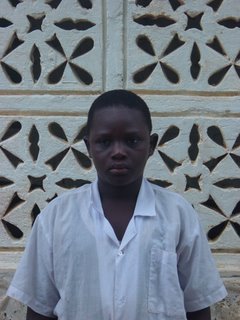
Normal (above) and swollen (below).

Along with Alhagie are his older brother Omar Dye, Omar's friend Sait, and Alhagie and Omar's mom Maram.
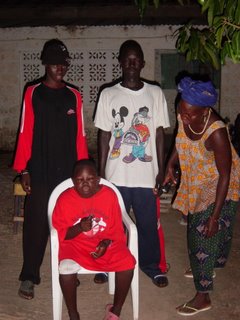
This was the source of much amusement, particularly to his mom Maram. Alhagie promptly covered himself with a muso/veil, and skipped two days of school out of pain and embarrassment (classes had not started yet). It was very difficult for me to prevent myself from laughing too, but I managed to restrain myself.
The next evening, though, Alhagie was a little more philosophical about his predicament and wanted to record it for posterity. So he asked me to take pictures. This was a very cathartic moment for me as I felt free to let out my laughter at the hilarity of Alhagie's appearance.
Please note that the first, before/normal picture of Alhagie was actually taken after the stinging. So you can see that he has safely recovered. But it will be some time until I forget the image of Alhagie struggling to see the meal in our food bowl.

Normal (above) and swollen (below).

Along with Alhagie are his older brother Omar Dye, Omar's friend Sait, and Alhagie and Omar's mom Maram.

18 September 2006
A visit with my friends Matarr and Mbombeh


Sorry, I forgot about this post until now. I started it in December. Here now are my friends Matarr and Mbombeh. In fact, I'm visiting them for lunch today.
Matarr and Mbombeh lived in Njau but moved to Latri Kunda, in Kombo, several months ago. When I'm in town I usually drop by and see them. So these pictures are from a visit there in April.
Top left is Matarr in the yellow vest. His son Mohamed is in red on the right.
In the picture on the right, Mbombeh is having her hair braided by her daughter Fanna, and her son Alieu is sitting in front.
The group of kids are enjoying some Jumkin (juice mix), an occasional treat.
The World/Gambia is Flat
29 August -- I've been passing the time reading "The World is Flat," a book my parents sent me for my birthday (among others - thanks guys!). The gist of the book is that the world is flattening or converging -- creating new opportunities and challenges for billions of people as barriers to education and employment come down. So I have been reading with some trepidation about this new world, considering the ramifications for The Gambia.
I am fearful that most of this country will miss out on this flattening of the global playing field. I haven't read the book's section of developing countries yet, but the author (Thomas Friedman) seems sanguine about the aggregate positive effects of globalization on the world's population. Unfortunately, Gambia seems largely removed from these changes. To be sure, modern communication is slowly proliferating, but the country seems to be falling further and further behind the rest of the world. There are some improvements, like the paving of the north bank highway, but these all seem to be driven by foreign donors. Most people want to go work overseas (and they do work hard if they get there), but the money made is devoted to micro-level changes here -- a nicer house, a few years of generator-provided electricity. Reading about legions of Chinese and Indians toiling away and improving their skills, it is difficult to contrast that with what I see here, where many teachers may not read a single book during the school holidays.
Yet just a kilometer from here is a functioning, albeit poor, country. All of Senegal's large towns have near-constant electricity. Even out here, if I walk 3-4 kms to Makorgui, the site of the nearest Senegalese school, the government has installed solar and the village has light at night. When I was riding a horsecart to my host mother's village for her brother's wedding I saw the ambient light in the distance, which I regarded with the fascination I would presumably reserve for an alien spaceship landing.
In short, I get rather discouraged when I think about Gambia's prospects. It's one of the reasons I'm contemplating another PC posting -- to visit a country where the attitude towards poverty and life is not largely one of abject resignation. To be sure, I exaggerate, and there are a lot of kids, and some adults, with lots of creativity, curiosity and motivation.
UPDATE: Having finished the book, I thought I'd comment briefly on the chapter on developing countries. I think Mr. Friedman's arguments that states should open up their markets, lessen red tape, invest in education and infrastructure and so on are laudable. And to the benificent leader who is not terribly enamored with remaining in office, these are great moves.
However, I see very little motivation for an administration that is less altruistic or visionary in outlook. Gambia has very little incentive in such a situation, as the leaders' hold on power and information would be negatively affected. As things stand, Gambia gets enough aid (some 60% of the education budget, for instance) that there is little financial pressure to increase surveillance of public employees or to reduce spending on wasteful projects.
The international community, too, seems to have a symbiotic relationship with an administration interested in touting minor infrastructure improvements. They draw positive attention for NGO's donors and Gambian citizens alike, both of whom rely on others for information -- the NGOs and the largely government-controlled Gambian media, respectively.
And Gambia's too insignificant for larger countries to pressure it to change, although America deserves credit for (quietly) dropping Gambia from its list of deserving countries receiving aid through the Millenium Challenge Grant/Account, or whatever it's called. More forceful follow-up is needed, though, if Gambia's leaders are to undertake more than piecemeal moves to improve governance.
I am fearful that most of this country will miss out on this flattening of the global playing field. I haven't read the book's section of developing countries yet, but the author (Thomas Friedman) seems sanguine about the aggregate positive effects of globalization on the world's population. Unfortunately, Gambia seems largely removed from these changes. To be sure, modern communication is slowly proliferating, but the country seems to be falling further and further behind the rest of the world. There are some improvements, like the paving of the north bank highway, but these all seem to be driven by foreign donors. Most people want to go work overseas (and they do work hard if they get there), but the money made is devoted to micro-level changes here -- a nicer house, a few years of generator-provided electricity. Reading about legions of Chinese and Indians toiling away and improving their skills, it is difficult to contrast that with what I see here, where many teachers may not read a single book during the school holidays.
Yet just a kilometer from here is a functioning, albeit poor, country. All of Senegal's large towns have near-constant electricity. Even out here, if I walk 3-4 kms to Makorgui, the site of the nearest Senegalese school, the government has installed solar and the village has light at night. When I was riding a horsecart to my host mother's village for her brother's wedding I saw the ambient light in the distance, which I regarded with the fascination I would presumably reserve for an alien spaceship landing.
In short, I get rather discouraged when I think about Gambia's prospects. It's one of the reasons I'm contemplating another PC posting -- to visit a country where the attitude towards poverty and life is not largely one of abject resignation. To be sure, I exaggerate, and there are a lot of kids, and some adults, with lots of creativity, curiosity and motivation.
UPDATE: Having finished the book, I thought I'd comment briefly on the chapter on developing countries. I think Mr. Friedman's arguments that states should open up their markets, lessen red tape, invest in education and infrastructure and so on are laudable. And to the benificent leader who is not terribly enamored with remaining in office, these are great moves.
However, I see very little motivation for an administration that is less altruistic or visionary in outlook. Gambia has very little incentive in such a situation, as the leaders' hold on power and information would be negatively affected. As things stand, Gambia gets enough aid (some 60% of the education budget, for instance) that there is little financial pressure to increase surveillance of public employees or to reduce spending on wasteful projects.
The international community, too, seems to have a symbiotic relationship with an administration interested in touting minor infrastructure improvements. They draw positive attention for NGO's donors and Gambian citizens alike, both of whom rely on others for information -- the NGOs and the largely government-controlled Gambian media, respectively.
And Gambia's too insignificant for larger countries to pressure it to change, although America deserves credit for (quietly) dropping Gambia from its list of deserving countries receiving aid through the Millenium Challenge Grant/Account, or whatever it's called. More forceful follow-up is needed, though, if Gambia's leaders are to undertake more than piecemeal moves to improve governance.
Eleven Things I Like About My Host Father
In homage to Chebo Ceesay. One day I will put up a picture.
1. He spends 150% of my rent money on ataaya.
2. When he hums along to "Ain't no sun shining when she's gone."
3. His son might be the fattest small boy in The Gambia.
4. He misses broccoli.
5. He reads with his son sometimes.
6. He doesn't beat his kids.
7. He has one wife and two kids and doesn't want more of either (especially the former).
8. His wife Maram asked me if albinos in America are black.
9. His older son fetches water for the compound [this is not considered men's work here].
10. His relative engagement with the outside world keeps me from forgetting how most people regard U.S. foreign policy.
11. When he calls to his wife, she answers "Ceesay!"
1. He spends 150% of my rent money on ataaya.
2. When he hums along to "Ain't no sun shining when she's gone."
3. His son might be the fattest small boy in The Gambia.
4. He misses broccoli.
5. He reads with his son sometimes.
6. He doesn't beat his kids.
7. He has one wife and two kids and doesn't want more of either (especially the former).
8. His wife Maram asked me if albinos in America are black.
9. His older son fetches water for the compound [this is not considered men's work here].
10. His relative engagement with the outside world keeps me from forgetting how most people regard U.S. foreign policy.
11. When he calls to his wife, she answers "Ceesay!"
17 September 2006
Pictures of Dakar, courtesy of Jeremy
My friend Jeremy sent me a disposable camera, and he has just sent the prints and a CD to me. These pictures are from my trip to Dakar, Senegal, in April 2006.
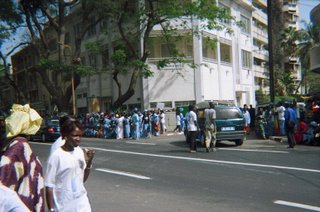
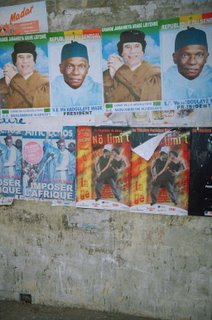
This is a small picture of the crowd in Dakar (it belies the scope) assembled for Independence Day celebrations and the procession of Senegalese President Abdoulaye Wade and everyone's favourite reformed dictator, Muammar Qaddafi. Below are posters of Wade and Qaddafi. Five other African heads of state came too, but they barely rated a mention in the national press, nor did they take part in the main parade.
Goree Island was a major waypoint in the slave trade. Nowadays it's a rather tacky environment, although there is some interesting architecture. Lots of restaurants and touts, though. The old forts (left relatively unmarred by tourism) in Ghana are much more thought provoking, and so is the ruined fort at James Island in The Gambia (nearby Alex Haley's "Roots" village Juffureh is not up to much).

This is a small picture of the crowd in Dakar (it belies the scope) assembled for Independence Day celebrations and the procession of Senegalese President Abdoulaye Wade and everyone's favourite reformed dictator, Muammar Qaddafi. Below are posters of Wade and Qaddafi. Five other African heads of state came too, but they barely rated a mention in the national press, nor did they take part in the main parade.

 |
| A view from the southern tip of Dakar. Also, Dakar is on the western tip of the peninsula that is the westernmost land on the African continent. During a future visit I shall trespass on Club Med grounds and make it to westernmost West Africa (Cape Verde excepted). |
 |
| A distant view of Goree Island. |
 |
| The Palais du Justice and main bus station. |
Subscribe to:
Posts (Atom)


![Expat [DESTINATIONCOMPLETE]](http://www.expat.com/logo/expatBlogSmall.gif)

