Showing posts with label Moka. Show all posts

27 February 2017

Moca – A Small Town and a White Elephant

Since we planned to visit Bioko Biodiversity Protection Program, we got in touch with the Drexel and UNGE-affiliated organization for tips on where to stay. It quickly emerged that the only game in town – well, a 30-minute walk outside town – was the Hotel Moca.

After combining on rides in a van with an exuberant Moroccan mother-daughter(?) duo, we eventually arrived at the hotel from the nearest significant town of Luba. To our surprise the Moroccans did not enter the hotel but instead walked straight ahead past a barricade into an enormous walled compound.


After settling in and finding no other guests but plenty of agreeable hotel staff, we traipsed back into town to find some food and drink.

The road back into Moca from Hotel Moca.
The first bar we found had a couple of surprises. First, it was run by a Cameroonian woman. She moved to Bioko Island five years ago, after a dispute with the Cameroonian education ministry led to the shutting down of the private school she ran. So now she was in Moca running a bar and general store, along with a couple of sewing machines for additional income. She also got satellite TV and was kind enough to share some coulacasha stew with us while we watched CRTV. The Cameroonian channel coincidentally featured the Fondom of Oku, including interviews with the Fon and his son, David, who showed us around the palace in March 2016.

The Fon of Oku and his son.


After a few beers we then walked back to Hotel Moca.

The turnoff towards Hotel Moca at night.
The next day we went on a hike with a couple of BBPP volunteers from the U.S., along with Fermin, who guided us up the hill for a view of Lago de Biao, the crater lake outside Moca. Since it was the rainy season the visibility was variable. The hike wasn't as arduous at Mt. Oku or Mt. Manengouba, and we had an informative time talking with Fermin, Dan and Dana about the local agriculture, BBPP's other projects (including drill tracking and recording turtle egg laying in December), and the state of the bush meat trade on Bioko Island. BBPP makes tallies of the amount of bush meat for sale in local markets (small antelope and large rodents being the main sellers). The government's enforcement of a bush meat ban has varied, but at times has had the effect of making the bush meat trade more lucrative.

It was a misty and overcast stay on Bioko Island!


After our damp hike we decided to decamp once more to the Cameroonian bar, where CRTV was now showing the Olympics. Cameroon's ladies volleyball team (who won the African championships on home soil a few months before to qualify for Rio) were a spirited team but could not overcome the Russians (I assume this is a sport with less doping than others).

Allez les lionnesses!


We then headed back to Hotel Moca for dinner. It turns out the Moroccan ladies live and work on the compound of a palace belonging to Teodorin, Nguema Mbasogo's son, who has a taste for expensive cars and palatial residences in Europe and California. Most of his cars and homes in France were seized by French authorities in an anti-corruption drive; his father appointed him vice president of Equatorial Guinea in the hopes of bestowing diplomatic immunity on him, but that has been unsuccessful so he is based in EG these days. One of his previous positions was as Minister for the Environment while simultaneously owning large stakes in timber companies.

Aside from referring to Moca as a "city," the sign was quite accurate.

There were several other Moroccans in Moca, working at the (usually vacant) palace and (also largely empty) Hotel Moca. There were of course Equatoguineans on the staff, too, but I remain curious about how a large number of Moroccans migrated to southern Bioko Island for work.

Approaching the dormant entrance!
We had a nice enough dinner while the national TV channel showed an aerobics program, and otherwise relaxed after the hike to Lake Moca. Each morning the rooms were made up, even if no one stayed the night.

Nice long hallways to ride your tricycle down!
One pleasant surprise of the trip, given the warnings of guidebooks and travelers, the BBPP staff, and the ordinarily difficult tourism permit process, was that we were stopped very infrequently by soldiers. Apparently after the latest coronation of Nguema Mbasogo (“37 more years!”), a new group of ministers were considerably more relaxed in the aftermath. Quite a contrast for a country that is shifting its capital to the mainland to better head off coup attempts – the most famous being the one bankrolled by Margaret Thatcher's son in 2004. I'm a little surprised Nguema Mbasogo would do this, given that all of the oil is near Bioko, but I suppose being close to one's hometown and surrounded by kinsmen has its appeal – witness Yamoussoukro, or Gbadolite, Mobutu Sese Seko's hometown (which benefited from government largesse even if it never became DRC's capital).

24 February 2017

Tips for Getting Your Equatoguinean Tourism Permit

The Equatoguinean Cultural Center had taxidermied rats drinking in a bar (see the San Miguels for the Spanish colonial influence), not to mention several more in the display playing banjos. They're surrounded by cocoa pods, as cacao was a major export in colonial times.
According to both the Bradt guidebook and the Bioko Biodiversity Protection Program project we planned to visit, acquiring a tourism permit in Equatorial Guinea (the visa is free on arrival) to travel anywhere outside the capital Malabo is an onerous task, often unsuccessful and costing around 15,000-20,000 CFA (approximately $25-33) per person (to be fair the price is very reasonable when compared to what western countries charge Equatoguineans when they apply for visas.

Cheery welcome at Internet Hostal, Malabo.
On our August 2016 return leg from São Tomé &Príncipe we stayed at Internet Hostal in Malabo, a dingy Chinese-run hotel with an attached Internet Cafe and free in-room desktop computers. The most entertaining element of our stay was the middle-aged Chinese woman whose only statements in Spanish were “Paga dinero” (with evolving intonation giving it meaning as a question, statement, demand or threat), with the occasional “Vente mil” and “Salir manana?” thrown in for good measure.

Casa Verde - prefabricated in Belgium in the early 19th century, and once a Portuguese consulate.
View from the eaves of Casa Verde. Teodoro Obiang Nguemba Mbasogo had recently been reelected. Many other billboards called for "37 + 37" - they want 74 years of his rule, no doubt.


The next morning, we started off with a taxi to the Departamento de Turismo y Cultura for the tourism permit. As we headed through Malabo II/Dos, where many new buildings for ministries are being built, with attendant highrises and estates for big men and oil workers and executives, it was difficult to gauge traffic – our driver was forced to slow down at all stop signs since high concrete walls meant there was no visibility.

Beautiful old houses abounded in Malabo.
We then meandered off the road onto a dirt path and Blair was certain we were about to be mugged in the bushes. The taxi's underbelly got snagged on a hill but the driver pressed on and we drove on to a pavement/sidewalk and turned left. It quickly became apparent that we were going the wrong way on a divided highway. This must be a routine occurrence, as opposing vehicles in the fast lane moved over without honking at us. A kilometer later we reached a roundabout where we resumed driving on the right side of the road.

Barbershop sign: Nelly giving President Barack Obama a haircut.
We reached our landmarks (Camera de Comercio, Arab Contractors) then crossed a footbridge toward the “social housing” where the ministry was located.

Spanish colonial era map (produced in 1944) of Bioko Island. Our main southern stops were Luba (formerly San Carlos) and Moka (name unchanged, although the spelling varies).
This was a fairly large group of government/public/social housing apartment buildings, so a kindly snack vendor pointed us in the right direction. After passing the pool/bar for Communitario Candy and knocking on a few doors, we bumped into a very helpful functionary outside one apartment block. Taking a moment to greet her and ask how she was doing that morning was reciprocated in kind, as she showed us where to go, made copies of our entry stamps, and asked the department secretary to type out our handwritten letter listing the places we would like to visit.

The National Library had a section focused particularly on Equatorial Guinea, featuring videocassettes of the series Poldark.
The letter needed reformatting (which the secretary again did for us), and we needed to go buy 1,500 CFA worth of polisas de solicitud (request stamps) at the Funcion Publica ministry up the road. Of course, the latter “could only be sold for 2,000 CFA” but, considering how kindly everyone in the Turisma apartment treated us, it was a small price to pay given the reputed difficulty of getting tourism permits.
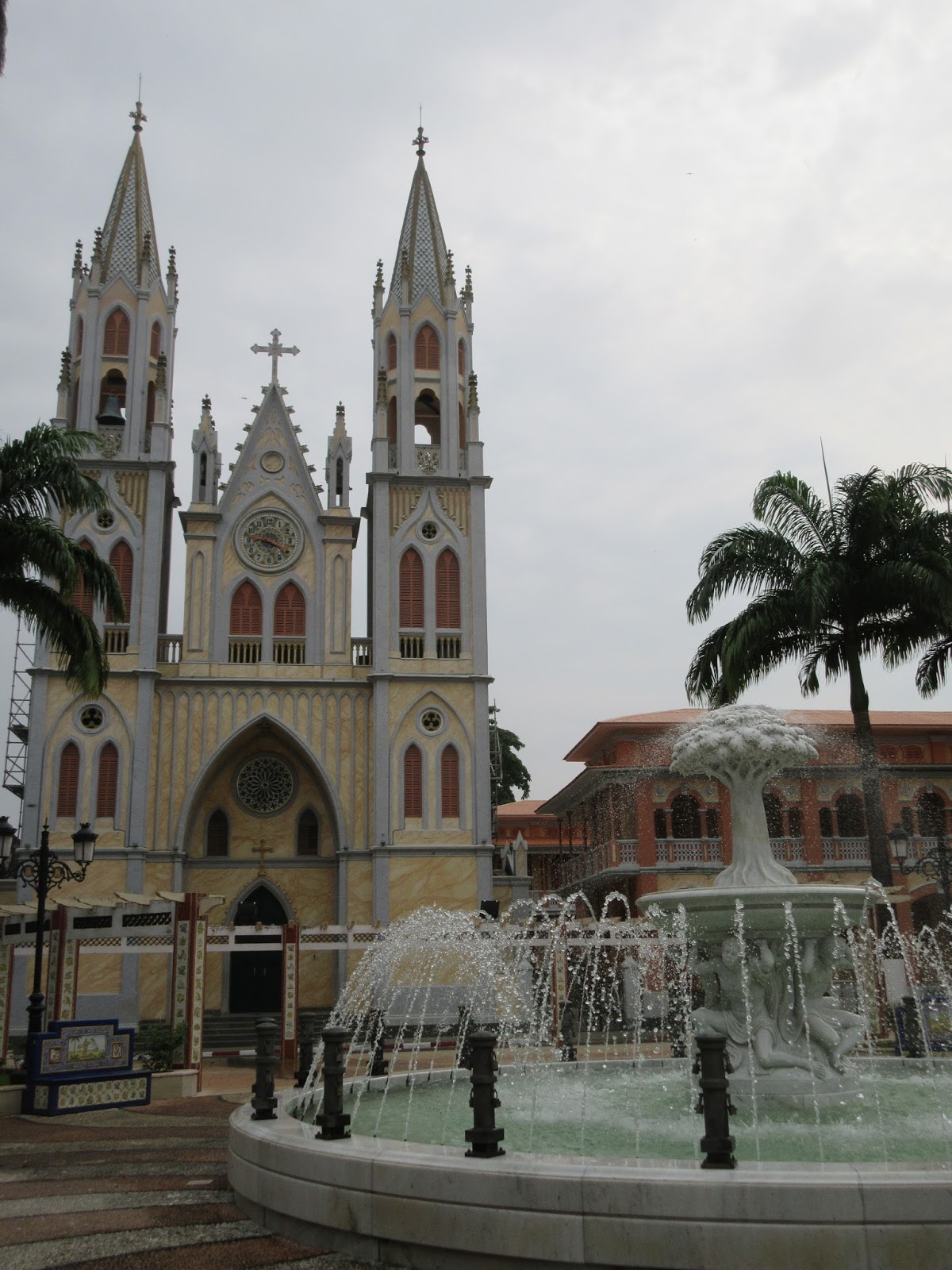
Santa Isabel Cathedral, with ceiba tree (one of EG's national emblems) water fountain.
This difficulty was confirmed when workers at BBPP got in touch with us for tips after subsequent tourists struggled to get their tourism permits. So we really were quite fortunate.

Cine Mar, longtime cinema and concert space, used by Nguema Mbasogo for public trials, including that of his uncle Francisco Macias Nguema, who he deposed in 1979.
One interesting thing about Malabo was that very few Equatoguineans remarked on our presence in their city; virtually none, in fact. It could be connected to the fact that there is a large population of expat oil workers around Malabo (during years of higher oil prices, there have been direct flights between Houston and Malabo – according to a parent at our school conditions in the Gulf of Guinea are quite similar to those in the Gulf of Mexico).This nonchalance represented a contrast to Cameroon, where touts in Douala and Yaounde are quite talkative and pushy, and to São Tomé and Príncipe, where comparatively gentler people were still apt to come up and talk with us. In Malabo, we may as well have been in New York City.

Plaque commemorating Cuban dissidents deported to Bioko Island (formerly named after Fernando Po) in 1869.