 |
| House opening onto a square in Batete, Equatorial Guinea. |
[From our August 2016 visit to Equatorial Guinea.]
Sandwiched between two bizarre white
elephants (the massive, apart-from-us deserted
Moca Hotel;
the Parque National, recently constructed by Teodoro Obiang Nguema
Mbasogo) was our visit to Batete, a small hilltop town in the south
of Bioko Island in Equatorial Guinea.
 |
| Madonna and child, Batete. |
Visiting the former Spanish Guinea, we
were forced to rely on our long-forgotten Spanish classes.
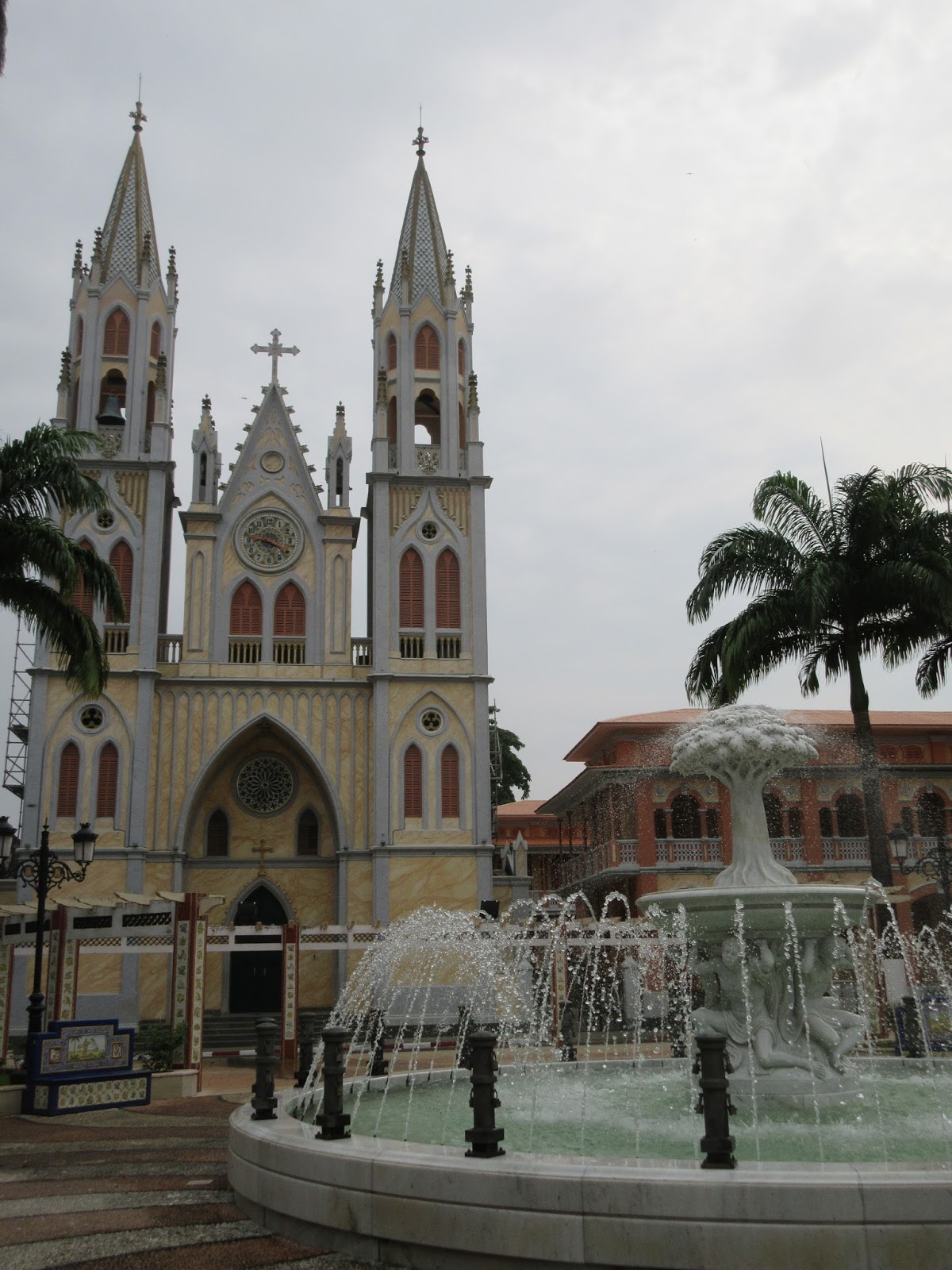
Approaching an old colonial outpost notable for its old church
(constructed mostly from wood in 1887), we expected more of the same.
We asked a couple of older ladies where the old church was and were
promptly informed, “There is no new church! That one's been
here for centuries.”
 |
| Mural recounting an early meeting between local peoples and foreign clergy. |
We passed a number of downtrodden yet
beautiful colonial buildings (despite the oil boom, Equatorial Guinea
has preserved a large number of charming buildings) and crossed a
small square. An older lady called after us, and soon was inspecting
our Tourism Permit (despite warnings that this would be checked
repeatedly by surly soldiers in a country with an infamously
paranoid leadership, this was the only time we had to
show this particular document). She then started calling out in
pidgin English, sending men in various directions in search of the
church key.
 |
| The Batete church's main entrance. |
In a somewhat remote portion of Bioko,
we were surprised to hear multiple people speaking to each other in
pidgin English. Our impromptu host, Mary, explained that many
Nigerians had come to work on Bioko Island (then Fernando Po) in the
1940s and 1950s. Mary, in turn, had lived in Nigeria for 14 years, in
Lagos, Port Harcourt, Calabar and Aba.
 |
| Some of the stained glass is original to 1887. |
[Under the first post-colonial
president, Francisco Macias Nguema, Nigerians were arbitrarily arrested and
several died in police custody, prompting Nigeria to evacuate all
their citizens. Macias also persecuted the original inhabitants of
Bioko, the Bubi people, and banned a people that relied on fishing
from using boats.]
 |
| Batete church interior. |
Despite several searches, the key did
not turn up so we set off with Mary (who was greeted throughout town
by kids exclaiming “Abuela!”) to the church. It was quite a
beautiful building, if a bit worse for wear like so many older
buildings. From outside the entrance you can also just see the ocean
down below (not very dramatic in pictures on account of rainy season
cloudiness). While we did not enter, one of the men who'd searched
for the key helped prop up a window and we stood on a ledge for a
view of the inside, which was quite charming and seemed to received a
fairly recent paint job.
 |
| Commemorating the church's centennial. |
Afterwards, Mary took us for a tour of
a boarding school. One of the Paraguayans that help run the school,
Antonio, was kind enough give us a tour. They have an active
gardening and farming program, which the students help with.
 |
| Boarding school in Batete. |
 |
| Screams don't teach. |
 |
| Equatorial Guinea's flag, coat of arms, and a talking drum in the school's auditorium. |
 |
| One last charming building in Batete. |
We then caught a taxi back down the
hill to Luba and onwards to Malabo. With a few hours to kill until
takeoff, we decided to check out the new Parque Nacional in Malabo
II. The massive park's construction had finished the month before,
and many features (some bathrooms, a couple of buildings) were not
yet completed. All the same, the setting was truly bizarre, especially
considering the old church in the hillside town we visited earlier
that day.
 |
| Parque Nacional, with presidential statues and choo-choo train people-movers. |
 |
Closeup of the president. If he's this well preserved he may well stay on for
the additional years ("37 + 37") the billboards around town call for. |
Upon entry we walked across a large
granite square (passing an amusement park-style train for taking
families around) to a massive statue of Nguema Mbasogo. He looked out
beneficently on the square, and we headed off to check out the
manicured lawns complete with music spouted from speakers variously
disguised as rocks, mushrooms and tree stumps.
 |
| The pagoda house, Parque Nacional, Malabo. |
We then traipsed around the grounds for
a couple of hours, admiring the manicured lawns, (transplanted?)
trees, statues based on the art of EG's different ethnic groups,
paddle boats, fancy bathrooms, artificial islands representing the
three smaller islands between Bioko and the mainland, and of course
“First Lady Planked Road.”
 |
| Golf cart stopping at the science section of the park, notable for its rainbow rings and marble orbs (they represent the solar system). |
A nice backdrop of the park (until
Malabo II completes its planned range of multistory buildings for
bureaucrats and oil workers) is Pico Basile, the volcano that rose up
to form Bioko Island. It's part of an arc of volcanoes stretching
from
São Tomé and Príncipe into the
western Cameroonian highlands incorporating Mt. Cameroon,
Mt. Manengouba and
Mt. Oku.
 |
| Pico Basile, as seen from Parque Nacional. |
While Parque Nacional was certainly a
nice diversion and a welcome bit of green space (it's much larger
than the closest competition I've seen in the region –
Bois Sainte Anastasie), one does wonder about the amount of money
lavished on this Central Park of Malabo. For a country with an
average per capita income around $12,000, the country could easily
afford to uplift its people. Instead, the vast majority of the
population languishes in poverty.
 |
| First Lady Planked Road. I'll let the sign do the talking. |
Once it got dark we headed over to the
airport for our 20 minute flight back to Douala. Ferry service
certainly seems like a good idea (a Cameroonian colleague of ours
took a much longer ride from Limbe to Calabar, staying quiet as much
as possible so she could pass as a Nigerian...), but Nguema Mbasogo
has a similar dim view of boats and ships as his predecessor Macias
did.
 |
| Bridges of Parque Nacional by night. |




![Expat [DESTINATIONCOMPLETE]](http://www.expat.com/logo/expatBlogSmall.gif)


