16 March 2007

A Madrassa in the City

I had long promised to visit my friend Bubacarr, who works as an Ustas (Koranic teacher) at a dara/madrassa in Thies, Senegal's second city, during the dry season. Bubacarr comes home to Njau to farm during the rainy season, so that's how I know him. So it was that, after the Magal and a stopover in Dakar, I came to visit Thies.

I expected that some parents in Njau and other villages had left their sons in Bubacarr’s tutelage. I was surprised to discover, though, that all of his talibes/students were from around Njau, having moved 300 kilometres away to Thies. It seemed to me counterintuitive that Bubacarr, an Njau native, and his talibes would leave their homes and families for an expensive, unfamiliar city in another country. As it turns out, the rationale is economic.

If Bubacarr’s madrassa were in Njau, parents would not be able to pay him for his services. There are rural madrassas where children toil in their Ustas’s fields (see my July 18 2006 post on this), but Bubacarr lacks the land for this to be a viable option.

Moving to Thies proved feasible, though. The talibes’ parents still don’t have any money, and there’s no subsistence work available, but one can get by thanks to the West African and Islamic values of hospitality and zakat (alms giving), respectively.

Bubacarr rents a compound where he and his 40 or so students live and study. With water fees (there’s a tap in the compound), rent comes to 12,000 CFA (about $22) a month – a heady sum when your students have no money, nor food. This is where the aforementioned kindness of strangers, prescribed by social and religious norms, comes in.

The talibes spend a couple of hours every morning out with old tomate paste cans (for taking collections), offering prayers to people kind enough to make a contribution. A similar thing happens at lunch and dinner. The children return home with extra rice from compound food bowls and divvy it up at meal times. Bubacarr, too, has a couple of neighbours that provide him with meals, out of respect for the work he does teaching children the Koran and Islamic values.

The talibes study for a few hours before and after lunch, and for another hour or so at night. Older students teach the younger boys, with Bubacarr there to teach the older guys and to answer questions that come up. Bubacarr likened his role to that of my headmaster at Njau’s primary school.

So Bubacarr’s dara relies solely on charity to operate. At first this seemed unrealistic, but if every kid collects 25-50 CFA a day that works out to 1000-2000 CFA. Bubacarr had enough to splurge 2500 CFA on dinner for us (leaving me feeling a little sheepish), and is even contemplating renting a slightly nicer room. The funds also supported his two wives (now three as he has married his brother’s widow) and children at home in Njau.

So the urban dara system, in this case, works quite well financially. On the other hand, living quarters are cramped, the diet’s not great (but on a par with Njau), and Bubacarr and his talibes are far from home. Also, one boy is there simply because he ran out of money to attend government school, and Bubacarr has poached a few other kids from Njau’s primary school. It would be nice if more children simply took the two track approach – about 30 Njau LBS students pay for extra Koranic classes with the school’s Ustas – rather than making it an either/or proposition, but the money’s simply not there to support a madrassa in Njau.

Addendum: I did a brief Internet search on talibes, and most posts deplored the living conditions of dara students. Although the living conditions are difficult, I saw a generally happy atmosphere at Bubacarr’s school, and the talibes seemed to be treated reasonably well.

15 March 2007

The Magal pilgrimage in Touba!

On 6 March 2007 I traveled from Njau for the Magal/annual pilgrimage to Touba, Senegal. Assembled here are some random notes from letters I’ve been writing to friends.

The Magal is celebrated by followers of the Mouride sect, and commemorates the founder’s return from 20 years’ French-imposed exile in 1907. So this city gets up to two million visitors during the Magal (to put that in perspective, I think Saudi Arabia allots passes for two million pilgrims for the Hadj). About half of Senegal’s 11-12 million people are Mourides and a fair amount of Gambian Wolofs are too (and some Mauritanians). I traveled there with Njau’s imam, an old pa (Baay Pateh) from Njau who’s keeping an eye on me, and a few other people from Njau and the surrounding villages (we hired a gelegele/minibus, which went off the beaten track, heading north from Njau). Quite a few other people from the Njau area are here; I bumped into the gelegele driver from our Grade 6 class trip last May, among others. The first afternoon we were there, I visited the mosque with Baay Pateh. It’s very large and ornate, and there are several adjunct shrines/mausoleums dedicated to past leaders of the Mourides. Every main street branching out from the mosque is filled with shops and sidewalk stalls (I think we passed over 100 cell phone stores). Many of the Senegalese working overseas are Mourides, and there’s a lot of trade back and forth. A major characteristic of this and other Muslim brotherhoods in the region is their reverence of their Serignes/marabouts/leaders, and their belief that these leaders can be conduits of messages or prayers to Allah. A lot of other Muslims might consider this elevation of leaders to be un-Islamic, but it dovetails nicely with local traditions of consulting wizened men for help with health, family, or financial problems or needs.

Besides checking out the market/city, we spent our time hanging out in three compounds that our imam and Pateh know (we are among hundreds of people sleeping in their courtyards), chatting with various pilgrims curious about my presence here, going on expeditions to places to take a bath (Baay Pateh knows a couple of compounds about 30 minutes’ walk from us that had pretty reasonable bathing places, plus we didn’t have to fetch water – one time Pateh simply pulled rank and used his seniority to annex one unfortunate young man’s bucket of water and place in line), eating, and resting.

So that’s about all I can tell you about Touba. Most of my information may not be completely accurate, and I use some terms interchangeably that may not be completely correct. Still, it gives you a small idea of what the trip was like, along with this little ‘survival guide’ which I’ve put together for prospective Peace Corps travelers to the Magal.

Magal Survival Guide

Although this won’t match the attention to detail in Tina and Nate’s Mauritania brief (“The pit latrine in the Atar PCV house issues a pleasant report when you drop a solid stool…”), I will do my best to be helpful. I highly recommend the trip to anyone who is curious (some command of Wolof or French is vital – or a companion with those qualities).

Try to leave a couple of days before the Magal, as traffic and accommodation both get really tight.

Travel with Gambian or Senegalese friends

If your village/town has a fair amount of Wolof compounds, there’s a decent chance there are Mourides among them (some Mauritanians are Mourides too). Travelling with locals should mean that logistics (transport, accommodation) are taken care of.

Bring your own water?

This was the suggestion of my host father, who claims cholera is widespread in Touba during the Magal. To be sure the taps end up surrounded by cesspools, and the water tastes awful. I brought along a 20 liter bidong for myself and the old pa whose fare I sponsored, but this only lasted two days as the less-prepared members of our party helped themselves. Bottled/shrink-wrapped water can be bought, but it sold out the day of the Magal.

Bathing

This could be a battle. You could borrow someone’s bucket, or bring your own. On the plus side, the taps always run. I lucked out as my old pa is a Magal old hand, and found us some good bathing places, although they were a half hour’s walk away.

Sleeping

Plan on sleeping in what you wear. You may want to bring extra layers, and socks, as it was quite chilly and you’ll likely be exposed to the elements. You’ll need a mat or something to roll out over the sand. Mats can be bought in Touba at the usual rates. Sleeping will be cramped; the last night we squeezed our mat between a compound wall and a taxi.

Visiting the Grand Mosque

This can be a bit tricky (although they apparently give tours during quieter periods), but it you dress the part, speak some Wolof (a little Arabic would probably completely flummox and quieten interrogators), and have someone who can vouch for you (Baay Pateh banged on about how I fasted over Ramadan and was generally living as they do), you should be fine.

Theft

The crowds are overwhelming, so try to stash somewhere on your person any valuables you don’t need at hand. I found my khaftaan quite handy as it covered the items in my trousers. I left my clothes and such where my people were ensconced and nothing was taken. Basically, the usual precautions apply.

Toilets

The standard pit latrines, just count on sharing it with a few hundred people.

Food

There are plenty of street vendors to buy food from, and tones of bitiks. If your host is a Serigne, or Mouride spiritual leader, he’ll want to make a good show of taking care of his acolytes. Breakfast was tea and bread; lunch was benichin with vegetables and beef(!); dinner was cous with sauce and more beef. It was kind of like Tobaski, except cows were slaughtered instead of rams or goats.

EXPENSES

Roundtrip fare from CRD-North: 5000 CFA / D 250 / $9
Large mat: 4000 CFA / D 200 / $7.50
Drinks: 300 CFA / D 15 per person per day / $0.50

Embargoed for Release – My Mauritanian Travels Revealed

In August 2006 I set off to Mauritania with my friend Fatou Jallow. She had visitors who were leaving from Dakar, so we met there. We spent a night in St. Louis, a very nice colonial town (the oldest French settlement in West Africa, I believe) on the coast (with the old part of town on an island) which was the colonial capital of Senegal and Mauritania. With independence St. Louis ended up in Senegal (though Dakar is now the capital) so Nouakchott (Mauritania’s capital) was an ad hoc creation. It’s now grown to a population of over a million, but it’s a dusty place without much to see. I think Kombo (the region outside Banjul) is somewhat livelier, and it has more amenities and places to go out to. Both have their well-heeled expat classes, but Gambia has tourists to cater to as well.

After a couple of days in Nouakchott we headed inland (though only 5kms from the sea NKTT is basically desert). There we based ourselves in Atar (relying on the hospitality of a PCV-Mauritania) and went on trips to Terjit (an oasis enveloped by small mountains) and Chinguetti (apparently the 7th holiest city in Islam, although I couldn’t say why). Terjit was really nice, as there was a little rock swimming pool in the stream, we could do a little hiking in the cooler hours (I use the word ‘hiking’ lightly but it was a different landscape after a year in a country that never rises more than 300 metres above sea level), we could engage in some people watching (Mauritanian families came for day trips and picnics), and one of the workers gave us free food from the other customers’ orders. Chinguetti was pretty too, and we went on a short camel ride and spent the night camping in the desert.

After that we shared the back of a pickup truck with ten other people and their luggage and headed north to Choum. Once there we hung out with our fellow passengers, drinking ataaya (the green tea with sugar that is ubiquitous throughout the region), eating dates, and chatting. Mauritanian transit towns have little rooms or covered areas where people can lay about on mats or mattresses, resting, chatting, drinking tea, or eating. After it cooled down a bit, some of the young men went out to play petanque/bocce ball. I had a few gos, but didn’t do very well. I can blame the heavy metal balls, grassless pitch, and the claim made by my companions that Mauritania is the 7th best nation in the world when it comes to petanque.

Several hours later, after 9 o’clock that night, the longest train in the world pulled into Choum. There is no station to speak of but, as this is the only northern route west to Nouadhibou, it stops there to pick up passengers. There is a passenger car in the back, but we and most other travelers opted for the tops of the other cars, where you pay no fare. After scrambling on top (with some of our companions from the truck), we set to work leveling the iron ore dust and settled down for the night. The ride was nice, though cold and (iron ore) dusty, and there wasn’t much to do besides look at the stars and desert and listen to the train rumble along the tracks.

After 13 hours and 400-500 kms (not a bad pace by Gambian south bank highway standards) we disembarked outside Nouadhibou. The train was quite an impressive sight in daylight (it’s said to be some 2.3 kms long), although the same could not be said for us. It took an hour-long shower to get myself reasonable clean, and I was still discovering pockets of iron ore dust a couple of weeks on.

Nouadhibou, Mauritania’s second city, was an interesting place, although we only had a day there. It’s right on the ocean, so it’s a bit cooler than NKTT, and you aren’t buffeted by dust from all sides – just three directions. It’s a big fishing port, one of the main industries in Mauritania. Most fishermen are black Africans (as opposed to fairer skinned, Arabic-looking Maurs), and some are from other countries, Senegal in particular. As a result, Nouadhibou is quite a diverse city, with lots of Wolofs and others around. Another, less positive, reason the city is a magnet for West Africans is that it is the prime launching point for boats of migrants aiming for Spain’s Canary Islands. From there we headed back to NKTT (which does have a nice market and okay museum) and then onwards to Senegal.

Overall I had a grand time in Mauritania. Language wasn’t too difficult, as I remembered French from some pre-Peace Corps courses I took in DC, plus we occasionally found Wolof speakers. A lot of Mauritanians travel to Senegal and Gambia for work (they run much of the fabric trade and many general stores in The Gambia), and Wolof is the lingua franca of trade in both places (to the chagrin of Mandinkas in Gambia).

Mauritanians on the whole treated us very well, and we experienced no problems in a country that is more conservative than SeneGambia. Before I traveled, a lot of Gambians warned me that “Naars” (Mauritanians of North African extraction) were wicked. I experienced nothing of this but I think that is because, as a visitor, I was no privy to the sometimes strained relations between more Arabic-orientated Mauritanians and black African Mauritanians, most of whom are from the southern area around the Senegal River, where there is some farming land. There have been race riots in the past, and black Mauritanians sometimes feel a bit marginalized economically and politically. Still, I saw generally friendly interactions between Mauritanians of all stripes. As for in The Gambia, the degree to which Mauritanians get along with Gambians varies from person to person. The same, of course, is true of PCVs in Gambia.

One potentially confounding way of life is the Mauritanian style of dress. Virtually all of the men wear either blue or white khaftaan tops, with no sleeves (the fabric does spill over the arms but is folded up), and with similar gold embroidery. In Gambia I use the (slight) variation in clothing as a crutch that helps me remember names. Black Eminem t-shirt – Eliman; blue Italy football shirt – Abdoulie; black halter top/tube top under shredded shirt – a boy named Samba; etc. I would not be afforded this luxury in Mauritania, with its uniform, albeit beautiful, national dress.

19 September 2006

A wasp strikes Alhagie!

So last week I came home in the afternoon, only to discover that my little brother Alhagie had been stung by a wasp on his hand and left cheek. It quickly swelled up and soon Alhagie had trouble seeing.

This was the source of much amusement, particularly to his mom Maram. Alhagie promptly covered himself with a muso/veil, and skipped two days of school out of pain and embarrassment (classes had not started yet). It was very difficult for me to prevent myself from laughing too, but I managed to restrain myself.

The next evening, though, Alhagie was a little more philosophical about his predicament and wanted to record it for posterity. So he asked me to take pictures. This was a very cathartic moment for me as I felt free to let out my laughter at the hilarity of Alhagie's appearance.

Please note that the first, before/normal picture of Alhagie was actually taken after the stinging. So you can see that he has safely recovered. But it will be some time until I forget the image of Alhagie struggling to see the meal in our food bowl.


Normal (above) and swollen (below).


Along with Alhagie are his older brother Omar Dye, Omar's friend Sait, and Alhagie and Omar's mom Maram.

18 September 2006

A visit with my friends Matarr and Mbombeh


Sorry, I forgot about this post until now. I started it in December. Here now are my friends Matarr and Mbombeh. In fact, I'm visiting them for lunch today.

Matarr and Mbombeh lived in Njau but moved to Latri Kunda, in Kombo, several months ago. When I'm in town I usually drop by and see them. So these pictures are from a visit there in April.

Top left is Matarr in the yellow vest. His son Mohamed is in red on the right.

In the picture on the right, Mbombeh is having her hair braided by her daughter Fanna, and her son Alieu is sitting in front.

The group of kids are enjoying some Jumkin (juice mix), an occasional treat.

The World/Gambia is Flat

29 August -- I've been passing the time reading "The World is Flat," a book my parents sent me for my birthday (among others - thanks guys!). The gist of the book is that the world is flattening or converging -- creating new opportunities and challenges for billions of people as barriers to education and employment come down. So I have been reading with some trepidation about this new world, considering the ramifications for The Gambia.

I am fearful that most of this country will miss out on this flattening of the global playing field. I haven't read the book's section of developing countries yet, but the author (Thomas Friedman) seems sanguine about the aggregate positive effects of globalization on the world's population. Unfortunately, Gambia seems largely removed from these changes. To be sure, modern communication is slowly proliferating, but the country seems to be falling further and further behind the rest of the world. There are some improvements, like the paving of the north bank highway, but these all seem to be driven by foreign donors. Most people want to go work overseas (and they do work hard if they get there), but the money made is devoted to micro-level changes here -- a nicer house, a few years of generator-provided electricity. Reading about legions of Chinese and Indians toiling away and improving their skills, it is difficult to contrast that with what I see here, where many teachers may not read a single book during the school holidays.

Yet just a kilometer from here is a functioning, albeit poor, country. All of Senegal's large towns have near-constant electricity. Even out here, if I walk 3-4 kms to Makorgui, the site of the nearest Senegalese school, the government has installed solar and the village has light at night. When I was riding a horsecart to my host mother's village for her brother's wedding I saw the ambient light in the distance, which I regarded with the fascination I would presumably reserve for an alien spaceship landing.

In short, I get rather discouraged when I think about Gambia's prospects. It's one of the reasons I'm contemplating another PC posting -- to visit a country where the attitude towards poverty and life is not largely one of abject resignation. To be sure, I exaggerate, and there are a lot of kids, and some adults, with lots of creativity, curiosity and motivation.

UPDATE: Having finished the book, I thought I'd comment briefly on the chapter on developing countries. I think Mr. Friedman's arguments that states should open up their markets, lessen red tape, invest in education and infrastructure and so on are laudable. And to the benificent leader who is not terribly enamored with remaining in office, these are great moves.

However, I see very little motivation for an administration that is less altruistic or visionary in outlook. Gambia has very little incentive in such a situation, as the leaders' hold on power and information would be negatively affected. As things stand, Gambia gets enough aid (some 60% of the education budget, for instance) that there is little financial pressure to increase surveillance of public employees or to reduce spending on wasteful projects.

The international community, too, seems to have a symbiotic relationship with an administration interested in touting minor infrastructure improvements. They draw positive attention for NGO's donors and Gambian citizens alike, both of whom rely on others for information -- the NGOs and the largely government-controlled Gambian media, respectively.

And Gambia's too insignificant for larger countries to pressure it to change, although America deserves credit for (quietly) dropping Gambia from its list of deserving countries receiving aid through the Millenium Challenge Grant/Account, or whatever it's called. More forceful follow-up is needed, though, if Gambia's leaders are to undertake more than piecemeal moves to improve governance.

Eleven Things I Like About My Host Father

In homage to Chebo Ceesay. One day I will put up a picture.

1. He spends 150% of my rent money on ataaya.
2. When he hums along to "Ain't no sun shining when she's gone."
3. His son might be the fattest small boy in The Gambia.
4. He misses broccoli.
5. He reads with his son sometimes.
6. He doesn't beat his kids.
7. He has one wife and two kids and doesn't want more of either (especially the former).
8. His wife Maram asked me if albinos in America are black.
9. His older son fetches water for the compound [this is not considered men's work here].
10. His relative engagement with the outside world keeps me from forgetting how most people regard U.S. foreign policy.
11. When he calls to his wife, she answers "Ceesay!"

17 September 2006

Pictures of Dakar, courtesy of Jeremy

My friend Jeremy sent me a disposable camera, and he has just sent the prints and a CD to me. These pictures are from my trip to Dakar, Senegal, in April 2006.


This is a small picture of the crowd in Dakar (it belies the scope) assembled for Independence Day celebrations and the procession of Senegalese President Abdoulaye Wade and everyone's favourite reformed dictator, Muammar Qaddafi. Below are posters of Wade and Qaddafi. Five other African heads of state came too, but they barely rated a mention in the national press, nor did they take part in the main parade.


A view from the southern tip of Dakar. Also, Dakar is on the western tip of the peninsula that is the westernmost land on the African continent. During a future visit I shall trespass on Club Med grounds and make it to westernmost West Africa (Cape Verde excepted).


A distant view of Goree Island.
Goree Island was a major waypoint in the slave trade. Nowadays it's a rather tacky environment, although there is some interesting architecture. Lots of restaurants and touts, though. The old forts (left relatively unmarred by tourism) in Ghana are much more thought provoking, and so is the ruined fort at James Island in The Gambia (nearby Alex Haley's "Roots" village Juffureh is not up to much).

The Palais du Justice and main bus station.

16 September 2006

post-Gambia travel plans - come along!

So it's a bit early to give much thought to my post-service travel plans (although the time is coming quickly - July 2007). But those of you in the real, workaday world, who may be inclined to join me for some of my wanderings but would have to budget and allocate time, deserve a sneak peak to consider it.

Here are my plans, such as they are. Essentially, I am going overland to Ghana, where I would probably then spend at least a few weeks. Everything in between is up in the air.

DEFINITE features of my itinerary:

- visiting Guinea, where a good friend is working (in Conakry), and where there is beautiful hiking (in the Futa Djalon);

- visiting Guinea-Bissau, and checking out the archipelagos just off the coast for a few days;

- the aforementioned return to Ghana after 8 years, to catch up with friends across the country;

- a visit to Senegal's Casamance region, intermittent skirmishes permitting

POSSIBLE waypoints and stops on the journey:

- Bamako-Dakar train - something I'd really like to do

- Togo

- Benin (esp. Abomey)

- perhaps Niger, and even Nigeria?


So, if you are interested in any or all of this trip, give it some thought and get in touch with me soon-soon. My plans are pretty flexible, so someone could join me just for a couple of weeks, and I could come meet you in whatever city you fly into. Getting here is expensive, but travelling around is more reasonable. There's not a lot of wildlife compared to east and southern Africa, but I was thinking of visiting a game park and traipsing around behind some elephants. Plus The Gambia has hippos! (Mali does too.)

I'm not too picky about what I need from a companion on the road. It couldn't hurt if you knew a little French. Mine is awful, but enough to get by on. Wolof isn't of much use beyond Gambia and Senegal, although some people spoke it in Mauritania. I will try to learn a little more Fula, but their dialects vary.

Come travel around West Africa with me! If I'd used my digital camera, I could have put up some pictures of Mauritania, which was a pretty amazing trip. Maybe I'll go through some of the other volunteers' files. My writeup on that adventure is coming soon.

15 September 2006

The Travails of My Trousers

Lazily taken from a letter I wrote to my good friend Harry while in Dakar, Senegal.

9 August -- My trousers are being held hostage by the Senegalese government. I discovered a tear along the seam of one of the legs yesterday, so today I took them to a local tailor and, after a prolonged negotiation, I left expecting to pick them up after lunch. I returned after 3, but the tailor's was still closed. Assuming he was still at lunch, I came back again a bit before 5.

When I got there, the men at the neighbouring store told me the tailor was gone, the place locked, and he might not return today. Given that I had (faint) hopes of leaving tomorrow morning, I found this a bit vexing. I asked if anyone knew the tailor's phone number, but they said no and, when pressed, that no one around there knew how to contact him. Cryptically, they said he doesn't have a key anyway.

So I settled down and played a game of foosball. Another thing that Senegal has over Gambia, besides electricity, roads, and the like, is foosball tables galore. Going down a town’s main street, I see one every two or three blocks. I don’t know if they are truly foosball mad (or perhaps the French brought higher smoking rates and a love of foosball to their colonies), but they are truly abundant.

A little later the tailor did return. He promptly told me the trousers were ready. I suggested that he fetch them. At this point one of the assembled men decides to tell me that he is the one in charge off the sewing booth – it resembles a freight container from a ship – but he cannot open it.

He explains that the space is rented from the municipal authority, which decided that afternoon to lock out tenants truant on their rent payments. He told me he would go tomorrow to pay his arrears and collect the key. When? In the morning, Insh’Allah (God willing). Does he have the money to pay the rent? No. Does he know where he’s going to get the money from? Nope. So, when might he be back to open the place if he does happen to get the money? After 1 o’clock, Insh’Allah. Reiterating that I may be leaving tomorrow does not faze him. In fact, he, the tailor and the rest of the crew found it all quite entertaining.

I have to admit it was amusing (aided in this hindsight as I was by a can of Carlsberg given to me by a Nigerian who stayed in the room across from me), but it crystallizes some depressing facts of life here – that so much depends on the arbitrary whims of government officials (the closings took place without any notice or warning), that nobody gives a shit when things are delayed or held up, and the compulsion to withhold information unless asked repeatedly.

24 August – In a happy ending, I picked up the trousers on my way back down from Mauritania!

Three kids from Njau


This is a photo in my house of Mariama Sallah, Sally Ceesay, and Fatoumata Sallah, who dropped by one evening for a little studying.

25 July 2006

Photos of the AgFo-Ed. group match


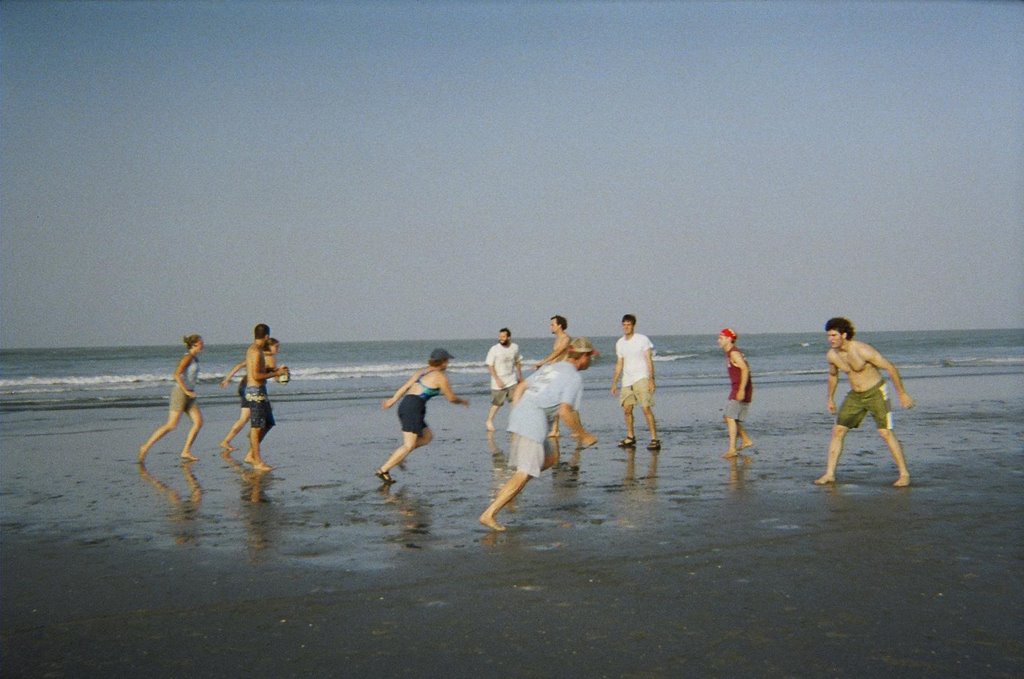
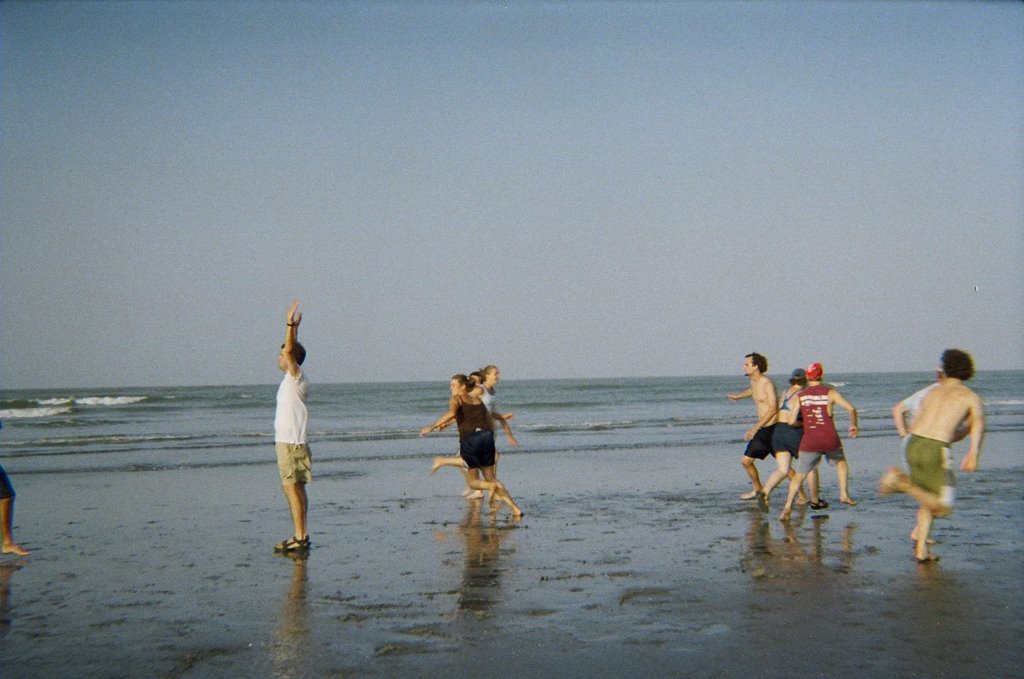
Pictures from our football match. Look at the beautiful Atlantic ocean. The education team is on defense on the right (I'm wearing red).

24 July 2006

Education volunteers dispel myth: they can run!

A few notes for the uninitiated: IST (In-Service Training), AgFos (AgroForestry volunteers), Ed(ucation)

Friday, March 31, saw the merciful end of our respective ISTs, and the new AgFos and newish Ed group decided to have an American football match on the beach.

The AgFos seemed pretty confident of victory in the days leading up to the match, and talked a lot of trash (Lie Sinyaan: "When I'm done with you, you're going to wish your daddy pulled out early."). The Ed group was a little intimidated by those taut, wiry bodies, honed by days working in the fields and searching for counterparts. Add to this the fact that we were missing three of our stalwarts - the sublime Robert (who was taking a bath), the insane Lie Njie (and the prospect of a post-football Frisbee game), and one of our tall man-eaters. But six months of watching kids kneeling in the sun with their arms over their heads meant that the Educators know a thing or two about doling out punishment.

Faced with the disinterest of half our team ("No lunch or per diem? Fuck it."), we managed to field 7 education volunteers for the 5-on-5 affair. By contrast, the AgFos came in droves, with a dozen or so willing participants. Still, the Teachers had a tight rotation and Jannetty, for one, tagged in and out with aplomb.

After a tentative first few series, the match was tied at 1. But a few defensive stops by the Education group put the score at 4-1, and the rout was on. The ignominy continued till a score of 10-6. At that point we decided to finish things off with a "first to three," leaving a total of 13-7. For one day, Tie-Dye Mai was known as Touchdown Maimuna, and Xaji came through with some incongruously athletic defensive plays. Yusufa was to opposing receivers what Katia is to dance partners. The wide margin of victory, however, prevents us from referring to it as a “grind it out win”.

Although cowed, and a little shellshocked, by the beating administered by classroom- and office-bound educators, the AgFos deserve some credit for their showing. Most of them turned out to play, in contrast to the lackadaisical education volunteers. Also, Peter had the block of the game when he put Guttridge flat on his back during one kickoff. They also bought us beers, the stakes of the game. One can only wonder if they regret freezing out Rodney, who apparently expressed interest in playing, and has wanted to lay Alieu out for a while now. Good dinner and drinks followed at the Sandplover.

Back at the Stodge, though, the AgFos rallied like true PCTG veterans, masters of the sedentary arts. Not ones for drowning their sorrows, they turned to the Stodge TV for comfort. The Ed vols, by contrast, were a little frightened by the content ("Texas Chainsaw Massacre") and retreated to the clubs of Senegambia.

In the meantime, the Ed group awaits a challenge (and the promise of hotties in the next Ed batch). Perhaps the health groups can offer more resistance?

18 July 2006

The guy with the mustache...

Well, my blog has been linked to by my fellow PCVs and some of our newly arrived Education trainees perused my page. I met the Wolof trainees this past weekend as I was asked by PC to go down to Sare Samba and help out a little. I managed to provide a little encouragement, chiefly by showing that after a year I am still pretty hopeless (and no longer remember how to set up a water filter). It was fun to revisit my old stomping grounds, and I really get on well with my old host family there. A couple of the trainees had visited my blog, and the chief thing they remembered was my facial hair of a few months ago. "Didn't you have a mustache once?" was the question.

Janitorial Hubris

From the annals of indignities heaped on our school caretaker…

Given the low rung on the pay scale occupied by our school caretaker, his attempt to become the only Njau Lower Basic School staff member to retain two wives was bound to raise eyebrows. With a lower salary than even our unqualified teachers (whose monthly earning were unfavourably compared by our deputy headmaster to the money needed to feed an English dog – see June 4 entry), Ebou Incha’s gambit to take on a recently-widowed mother of three children seemed a classic case of overreach. Ousainou, our headmaster and, along with my host father Chebo, a staunch advocate of having only one wife, was quick to announce his disapproval of Ebou’s assuming this added financial burden. Alas, a great many destitute Gambian men cannot resist the allure and status of a second wife (which aims to obfuscate, yet simultaneously worsen, their sorry financial states), and Ebou Incha proved no exception. After Ebou gave a warugar/bride price which included two cows, the new wife Jai arrived at the beginning of the 2005-06 school year, just preceding my own arrival.

It wasn’t long afterwards that Ebou pointed to his onerous financial obligations when I pestered him about his daughter Incha’s dropping out of school. It soon came to light, too, that Ebou’s first wife Sohna was not happy to have Jai join the household, with the ill feelings exacerbated by the compound’s precarious financial footing. Soon Jai was spending most evenings in a neighbouring compound which I sometimes visit. Jai often bugged me about buying her stuff but, as I get that treatment from quite a few people, I thought little of it. After about six months of acrimony and deprivation, Jai decided she’d had enough and returned to her in-laws’ across the river in Niamina.

Following this turn of events, the women of Njau decided to do a “roast” of Sohna – Ebou’s first wife. To the accompaniment of drumming and dancing the women teased Sohna, needling her for driving away Jai, who could’ve been a big help with work around the compound and on the farm. Ebou recounted this final humiliation to Ousainou, with the coup de grace being that Malick Ceesay (yours truly) came along to watch insult be heaped on top of injury (in truth I came for the music and dancing and only learned of the event’s agenda later on).

Career Advancement and Self-Improvement vs. The Siren's Call of Green Tea

July 7 – The choice may seem obvious to the uninitiated, but when I returned to Njau from an 8 km walk to Mbolgoh and Njokoben to greet parents and explain their children’s report cards and exam results (and my hopes to get half the kids to repeat Grade 1), I discovered two of Njau’s “unqualified” teachers waiting for transport at the police station cum gelegele stop. It was 7:30 in the evening and my erstwhile colleagues were hoping to travel to Mansa Konko, where the next morning they would take (and hopefully pass this time) the entrance exam for The Gambia College’s teacher certification program.

Given that the journey entails at least three gelegele/minivan rides (and the potential for breakdowns) and a ferry ride, plus the fact that Friday, being the Sabbath, is a horrible day for catching transport, a noontime departure is prudent – especially when considering the stakes. If I have to be in Mansa Konko by a certain time, I’d allow 8 hours on a normal day.

Today was (mercifully) the last day of school (we assembled to give out report cards and tutus…), which let out at 11AM. As I left to begin my catchment village tour, the teachers settled down to brew some ataaya (Chinese green tea with lots of sugar). This included our two prospective teachers, who one might have expected to want to leave early to be well-rested in advance of an exam they’ve already failed a few times. They too hunkered down, though, for two full brewings (a batch of ataaya features three progressively sweeter rounds) that took them well into the afternoon. Once I’d arrived and greeted the police and my colleagues, one of the teachers bemoaned their difficulty finding transport at this late stage. This was one of those rare occasions where I managed to bite my tongue; a year of haranguing teachers about the seemingly obvious is wearing on me and the rainy season break is arriving in good time.

Rock The Vote, Gambian style

July 5 – In the days following the AU summit, when 35 or so heads of state (along with the presidents of Iran and Venezuela…) descended on Banjul for a few platitudes and a joint statement denouncing coups (future ones, not the ones that brought to power some of these leaders, including the host), President Jammeh has shown his gratitude to a compliant populace by giving the country (well, those with government jobs or at banks and the like) four days of public holidays.

So school is finishing today (Wednesday) instead of on Friday. This combined with the fact that we had Monday and the previous Friday off, put paid to my hopes of our headmaster holding an end-of-year staff meeting (or even a 2006 one).

One sector of government is working quite strenuously, though, unlike the schools, which are giving added meaning to the phrase going out with a whisper. The “Independent” Electoral Commission is in town, registering voters for the upcoming presidential elections (variously projected to take place between September and November). Suffrage is universal from age 18, so I was a little surprised to see some of my 6th, 5th and even 4th Grade students lining up to join the democratic process. To be sure, some of our students are a few years older than their corresponding grades (and some PCVs working in high schools have students older than them), but I don’t think that even any of our Grade 6 students are as old as 18.

In lieu of birth certificates and immunization cards, which inconveniently have closer approximations of birthdates, the children have statements ghostwritten by relatively literate young men (who are back in town for the rainy season), then stamped by their alkalis (village chiefs). It’s a reasonably effective, albeit obvious, racket, as the ruling party (the president appoints district chiefs who in turn oversee the alkalis in their area) will have the alkalis turn out the (pre-selected) new registrants later to augment its take at the polls.

As a result of this registration drive, we’ve been missing our Deputy Headmaster, who’s also our Grade 1 teacher, for the past three weeks. He’s hoping to parlay his working for the ruling party/electoral commission into a headmaster post – a position he’s consistently failed to carry out in the past. He’s been so abysmal, in fact, that he’s been demoted to deputy status (no mean feat).

The upshot of this is that your correspondent found himself in charge of writing, giving and grading exams for over fifty Grade 1 students. I decided to be thorough and this, combined with questioning administered haltingly in English, Wolof and Fula, meant that I spent 20 hours alone on giving the exam, not counting treks to outlying villages to test students who’d been absent. The upside of this is that I have a very clear idea of what our first graders know, and don’t know. Still, after over 1000 minutes of showing students numbers (for example: “6”, answer: “W”) and letters (flashcard: “F”, response “21”), it gets a bit draining. As of now my main goal for the summer is to venture out to our catchment villages to explain the report cards to parents, do a little farming, and bugger off to Mauritania and Senegal for three weeks.

A little about the competition

29 June 2006 – Tonight I visited Musa and Fana Ceesay, whose 5 year old son Mam Sheikh has left the school’s nursery class, and is now studying at a dara (madrassa) in Darou, a km away from us in Senegal. So I dropped by to see if I could encourage Mam Sheikh’s return. Musa and his brother Sheikh, a teacher at Njau’s school, are both well-educated and could help Mam Sheikh, who’s a bright boy, to do well.

Musa was quick to mollify me, however, explaining that after two years in Darou, Mam Sheikh would re-enroll at Njau for Grade 1. His plan to give Mam Sheikh a little grounding in the Koran sounded reasonable enough.

As Musa went on, though, I felt less at ease. He explained that the students spend the morning farming in the school’s fields, then study after lunch. He noted that the teachers are very strict (a strong statement given some of the sadists in DOSE’s employ), and the children don’t sleep on beds (or under mosquito nets) and only bathe once a week or so. Musa said that Mam Sheikh used to be very playful (he is five, after all), but now his demeanour has totally changed. I had to concede that point to Musa, although I haven’t seen Mam Sheikh recently.

05 June 2006

A trip to the stone circles

Here are a few pictures from my second visit to Wassu's stone circles, about 40 kms east of Njau. I've since made a third trip, a Grade 6 class trip, and always have a nice time there.

No one knows much about the laterite stones, although some have been there for 1200 years. Some of them surround burial sites of (presumably) important people, and they vary from a few feet in size to three meters tall.

Maimuna (tie-dye), Fatou J. (red bandanna) and I visited them in April, and stopped by to see Julie (pink trousers), a volunteer who lives in Wassu. As you can see, we made pyramids.


04 June 2006

Assorted quotes from Gambian teachers

Obviously, these tend to obscure the fact that many people here are working hard, with little training and support, for a pittance -- as our Deputy Headmaster put it, the salary for "Unqualified Teachers" (those without a teaching degree) is "less than it costs to feed a dog in England." That said, these are entertaining.

"Get out of here before I beat you!" -- an Njau teacher address yours truly.

"Children who ask for help with homework are weak." -- another Njau teacher, on the appropriateness of assisting students after school.

"I really haven't done any work these two terms." -- My counterpart, in a meeting with me. The day before he heard that he'd been nominated for Headmaster/Principal of the Year.

"The people here are very nice and hostile." -- Grade 4 teacher at Sare Samba Lower Basic School, minutes after beating students who failed his vocabulary test.